
In short: This guide reveals current e-waste prices in South Africa for 2026 (R5-3,000/kg depending on type), explains which electronics are worth the most money, and shows you how to get the best price when selling to a professional recycling facility.
E-waste prices in South Africa vary dramatically based on the type of electronic waste you’re selling. In 2026, you can expect to receive anywhere from R5 to R3,000 per kilogram depending on the precious metal content and grade of your materials. High-value items like ceramic CPUs and server-grade circuit boards command premium prices due to their significant gold and palladium content, while lower-grade electronics such as old televisions and household appliances yield more modest returns.
These prices reflect the global surge in precious metal demand throughout 2025 and into 2026. Gold prices have remained above $2,000 per ounce, while copper and palladium continue their upward trajectory driven by increased industrial demand and supply chain constraints. At South Group Recycling, we use advanced sorting and analysis techniques to determine the exact value of your electronic waste, ensuring you receive fair market compensation for every kilogram.
📋 What This Article Covers
E-Waste Market Overview: What’s Driving Prices in 2026?
The e waste recycling market in South Africa has grown significantly in recent years, driven by increased awareness of environmental responsibility and the valuable materials contained within discarded electronics. According to the Global E-waste Monitor 2024, South Africa generates approximately 500,000 tonnes of electronic waste annually, yet only a fraction is properly recycled – representing both an environmental challenge and an economic opportunity.
Several factors influence e-waste prices in 2026. Global precious metal markets remain strong, with gold trading above $2,000 per ounce and copper prices elevated due to increased demand from renewable energy and electric vehicle manufacturing. The London Metal Exchange reports that secondary sources like recycled electronics now supply approximately 30% of global copper demand, making urban mining an increasingly important industry.
South Africa’s Extended Producer Responsibility (EPR) regulations, implemented under the National Environmental Management: Waste Act (NEMWA), have also reshaped the market. These regulations require electronics manufacturers and importers to take responsibility for end-of-life products, creating structured collection and recycling channels that benefit both sellers and the environment.
How Do Precious Metal Prices Affect E-Waste Values in 2026?
Precious metal prices directly determine how much you can get for your electronic waste recycling materials. When gold, silver, copper, and palladium prices rise, the value of your e-waste increases proportionally because these metals become more valuable when extracted and refined. Circuit boards, processors, and connectors all contain recoverable quantities of these precious metals.
A typical computer motherboard contains approximately 0.2-0.5 grams of gold, along with significant quantities of copper, silver, and palladium. When gold trades at R40,000+ per gram (reflecting the January 2026 exchange rate), even small quantities become economically significant. High-grade server boards and telecommunications equipment contain even higher concentrations, which explains their premium pricing.
Professional recyclers like South Group track daily commodity prices and adjust purchasing rates accordingly. This means selling during periods of high metal prices can significantly increase your returns. We recommend monitoring market trends if you have substantial quantities of e-waste to sell.
What Types of E-Waste Are Worth the Most Money?
The highest-value e-waste categories are those containing concentrated precious metals: ceramic processors, RAM modules, server-grade circuit boards, and telecommunications equipment. Understanding these categories helps you maximise returns and avoid underselling valuable materials to uninformed buyers.
E-Waste Price Overview by Category (South Africa 2026)
| E-Waste Category | Price Range (ZAR/kg) | Precious Metal Content |
| High-Grade Circuit Boards (servers, telecoms) | R80 – R250 | High gold, palladium |
| Medium-Grade Circuit Boards (PCs, laptops) | R40 – R100 | Moderate gold, silver |
| Low-Grade Circuit Boards (TVs, appliances) | R5 – R30 | Low precious metals |
| RAM Sticks | R150 – R400 | High gold content |
| CPUs/Processors (ceramic) | R500 – R3,000 | Very high gold |
| CPUs/Processors (plastic) | R50 – R200 | Moderate gold |
| Mobile Phones (whole) | R5 – R50 per unit | Mixed metals |
| Hard Drives | R10 – R30 | Aluminium, rare earths |
| Power Supplies | R5 – R15 | Copper, low-grade PCB |
Note: Prices are estimates based on January 2026 market conditions. Actual values depend on analysis, condition, and current commodity prices. Contact South Group Recycling for a precise quote.
How Much Are Scrap Circuit Boards Worth per Kilogram in South Africa?
Scrap circuit boards range from R5 to R250 per kilogram depending on their grade and origin. The grading system categorises boards by their precious metal content, which varies significantly based on the original equipment’s purpose and manufacturing era.
High-grade boards from servers, telecommunications equipment, and industrial machinery command premium prices because manufacturers use more gold plating on connectors and higher concentrations of palladium in components. These boards can fetch R80-250 per kilogram. Medium-grade boards from desktop computers and laptops typically sell for R40-100 per kilogram, while low-grade boards from televisions, DVD players, and household appliances bring R5-30 per kilogram.
Many people don’t realise that seemingly worthless old electronics contain valuable circuit boards. A single outdated server can contain 2-5 kilograms of high-grade board material worth R200-1,000. Learn more about electronics you might be overlooking: The Invisible E-Waste Problem: Devices That Never Get Recycled.
How Much Can I Get for Old Computers in South Africa in 2026?
Old computers are worth R30 to R2,000 depending on the type, age, and configuration. The value comes primarily from the CPU, RAM, and motherboard – the three components containing the highest concentrations of recoverable precious metals.
Old Computer Values in South Africa (2026)
| Computer Type | Price Range (ZAR) | Most Valuable Components |
| Desktop PC (complete) | R50 – R300 | CPU, RAM, motherboard |
| Laptop (working) | R100 – R500 | CPU, RAM, battery |
| Laptop (broken) | R30 – R150 | Circuit board, RAM |
| Server (rack unit) | R200 – R2,000 | Multiple CPUs, RAM, boards |
| Workstation | R150 – R800 | High-end CPU, RAM |
| All-in-One PC | R50 – R200 | Motherboard, RAM |
Servers command the highest prices because they typically contain multiple processors, large quantities of RAM, and high-grade motherboards. A single decommissioned enterprise server can be worth R500-2,000 in recyclable materials. If your business is upgrading IT infrastructure, the old equipment represents significant recoverable value.
Older computers (pre-2010) often contain more valuable materials than newer models because manufacturers used higher gold concentrations before cost-reduction measures became standard. Don’t assume that newer means more valuable – in e waste management, age can actually be an advantage.
What Are Old Mobile Phones Worth in South Africa in 2026?
Old mobile phones are worth R2 to R200 per unit depending on the model, condition, and whether they’re sold individually or in bulk. While individual phones may seem insignificant, the average South African household has 2-4 unused phones in drawers – collectively representing meaningful value.
Mobile Phone Values in South Africa (2026)
| Phone Type | Price Range (ZAR/unit) | Notes |
| Smartphone (working, recent model) | R50 – R200 | Data wipe required |
| Smartphone (working, older model) | R20 – R80 | Still has component value |
| Smartphone (broken/cracked) | R10 – R50 | PCB and metals value |
| Feature phone (working) | R5 – R20 | Lower precious metal content |
| Feature phone (broken) | R2 – R10 | Minimal value |
| Bulk phones (100+ units) | R15 – R40 avg | Volume pricing available |
Bulk sellers receive better per-unit pricing because collection and processing costs decrease with volume. If your business collects phones through trade-in programmes or if you’re a repair shop with accumulated broken devices, bulk selling can increase your returns by 20-40%.
Important: Before selling any phone, ensure all personal data is wiped. At South Group, we offer certified data destruction services that comply with POPIA (Protection of Personal Information Act) requirements, providing documentation for your records.
Where Can I Sell My E-Waste Legally and Safely in South Africa?
You should sell your e-waste to a licensed recycler registered with the Department of Environment, Forestry and Fisheries. Licensed ewaste recycling facilities operate under strict environmental permits that ensure proper handling of hazardous materials, fair pricing practices, and legal compliance for all parties.
South Group Recycling operates throughout South Africa with full environmental permits and ISO certification. We collect materials from businesses and individuals across all provinces, offering competitive pricing based on accurate material analysis. When you work with a licensed facility, you receive proper documentation of the transaction – essential for corporate compliance and environmental reporting.
Avoid selling to informal buyers, scrap dealers without proper licensing, or exporting e-waste illegally. South Africa’s e-waste regulations prohibit exporting electronic waste to countries with less stringent environmental standards – violations can result in significant penalties for sellers.
Why Do E-Waste Prices Vary So Much Between Different Electronics?
E-waste prices vary dramatically because different electronics contain vastly different quantities of recoverable materials. A server-grade circuit board might contain 20 times more gold than a television circuit board, even if they weigh the same. Understanding these differences helps you identify the most valuable items in your e-waste stream.
Manufacturing purpose determines precious metal content. Equipment designed for reliability (servers, telecommunications, industrial controls) uses more gold plating and higher-quality components than consumer electronics designed for cost efficiency. This is why enterprise IT equipment consistently commands premium recycling prices compared to household electronics.
Age also matters significantly. Electronics manufactured before 2005 often contain higher precious metal concentrations because manufacturers hadn’t yet implemented aggressive cost-reduction measures. Older ceramic processors, in particular, can contain several grams of gold – making them among the most valuable items in the e-waste stream.
What Documentation Do Businesses Need to Recycle E-Waste Compliantly?
South African businesses must maintain proper documentation when disposing of electronic waste to comply with NEMWA and EPR regulations. Required documentation includes waste manifests, destruction certificates for data-bearing devices, and records demonstrating that materials were processed by licensed facilities.
For a complete overview of compliance requirements, review our detailed guide: E-Waste Compliance Checklist for South African Businesses. This resource covers everything from initial assessment to final reporting requirements.
POPIA compliance adds additional requirements for businesses disposing of data-bearing devices. Hard drives, phones, and any storage media must be securely wiped or physically destroyed, with certificates provided as proof. South Group offers certified data destruction services meeting international standards, providing the documentation your compliance team requires.
How South Group Ensures Fair and Transparent Pricing
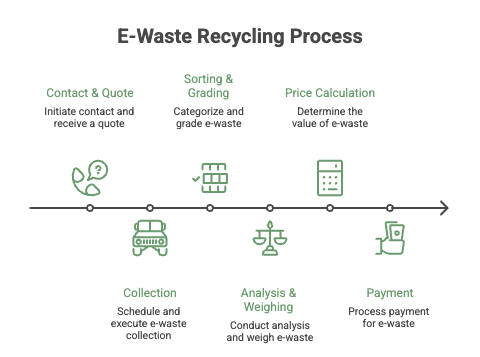
Getting fair value for your e-waste requires accurate assessment of actual material content – not guesswork based on weight alone. Many buyers use generic per-kilogram rates that undervalue high-grade materials while overpaying for low-grade items. Our approach differs fundamentally.
South Group uses systematic sorting and grading processes to categorise every item by its actual recoverable content. Circuit boards are separated by grade, processors are identified by type, and each category receives appropriate pricing based on current commodity markets. This precision benefits sellers with quality materials while ensuring sustainable pricing for all parties.
We provide detailed breakdowns showing exactly how your payment was calculated. Transparency builds trust – you can verify that pricing reflects actual material values rather than arbitrary estimates. For large volumes, we offer on-site assessments before collection, giving you a firm quote before committing to the transaction.
The Environmental Importance of E-Waste Recycling
Proper e waste recycling serves critical environmental purposes beyond generating income for sellers. Electronic waste contains hazardous materials including lead, mercury, and cadmium that cause significant environmental damage when landfilled or improperly processed. Responsible recycling prevents these toxins from contaminating soil and groundwater.
According to the United Nations Environment Programme, recycled electronics reduce the need for virgin mining operations that consume massive amounts of energy and create significant pollution. Recovering one tonne of circuit boards yields more gold than mining 17 tonnes of ore. Your e-waste literally reduces the environmental footprint of the global metals industry.
South Group is committed to sustainable practices that benefit both customers and the environment. We process all materials locally within South Africa, ensuring full traceability and preventing illegal exports to countries with inadequate environmental protections.
Ready to Sell Your E-Waste?
If you have electronic waste and want to receive fair market value based on accurate material assessment, South Group Recycling is ready to help. We serve businesses and individuals throughout South Africa with transparent pricing, professional service, and prompt payment. Whether you have a single box of old phones or an entire data centre to decommission, we provide the same commitment to fair dealing and environmental responsibility.
Visit South Group Recycling to learn more about our services, or contact us directly for a quote on your e-waste materials. Take advantage of strong commodity prices and convert your unused electronics into cash today.