
Key Takeaways
- Serious buyers want assay results, moisture data, impurity details, and lot size upfront – not hopeful estimates
- The first market number you hear is a reference point, not your final payout
- Tin tracks LME exchange references more closely than tantalum, which is often more negotiated
- Moisture, penalties, transport, and finance costs can change a quote fast
- Fake letters of credit and “pay after export” deals remain the biggest risks for African sellers
- South Group Recycling provides local mineral trading support across Johannesburg, Cape Town, Pretoria, and Durban
To sell tin and tantalum successfully in South Africa, prepare the file before you ask for price ideas. That means a recent assay from a credible lab, moisture and impurity data, realistic lot size, and clean ownership records. Buyers are not just buying weight – they are buying payable metal, expected recovery, and confidence in the paperwork. Sellers who understand the pricing formula, refuse weak payment terms, and work with a local mineral trading partner consistently get better outcomes than those who chase the highest nominal number. With tin prices at record highs and tantalum demand rising alongside 5G and EV growth, the commercial opportunity for well-prepared South African sellers has rarely been stronger.
Why Is Selling Tin and Tantalum Different From Selling Scrap or Bulk Ore?
Because buyers are not just buying weight. They are buying payable metal, expected recovery, and confidence in the paperwork – and that changes everything about how you need to prepare and present your lot.
Grade, Chemistry, and Trust Drive the Deal
Grade, chemistry, and trust drive the deal because they are the only three things a buyer cannot verify from a photo – and without all three, no serious capital moves. A pile that looks valuable may still get a weak offer if the sample is poor, the moisture is high, or the seller cannot prove where the material came from. That is why experienced sellers prepare the file before they ask for price ideas. The difference between a professional mineral trading transaction and a bulk scrap sale is documentation, not muscle. Buyers who put real capital on the table need to know that what you describe matches what arrives at their facility.
Why Many First-Time Sellers Target the Wrong Buyers
Many first-time sellers approach any metal buyer instead of the right specialist. Tin and tantalum buyers usually want specific grades, forms, and paperwork – and they do not all overlap. Some sellers assume that interest in one class of minerals means broad interest in every mineral lot. That assumption wastes time. A buyer focused on one category may have no appetite for mixed ore, off-spec concentrate, or very small parcels. Before you send photos and claims, ask what materials the buyer actually accepts, what minimum grade they need, and what their minimum lot size is. Specialist buyers operating in mineral trading are upfront about all three before any serious discussion begins.
Each Market Has Its Own Rules
Experienced traders do not lump tin, tantalum, concentrates, ore, and rare earth minerals into one bucket. Each market has its own quality checks, payout method, and acceptable risk level. According to the USGS Mineral Commodity Summaries 2026, both tin and tantalum are tracked as critical industrial minerals tied to electronics and advanced manufacturing sectors – but the supply chains, end markets, and recycling flows behind each are structurally different. Demand drivers for tantalum, tin, niobium, and beryllium in 2026 look very different from one another, and that means each requires a different sales approach, different documentation, and often a different specialist buyer.
What Do Serious Buyers Want to See Before They Quote?
They want proof. A serious quote starts with objective information, not hopeful estimates – and for most tin and tantalum deals, the buyer will look at four things first: assay, moisture, impurities, and quantity. If one of those is missing, the number you get will usually be wide, conditional, or low.
The Core Documentation Every Seller Needs
At a minimum, have a recent assay report, sampling notes, lot weight, and photos ready. If you have chain-of-custody or origin records, include those too. A buyer wants to know how the sample was taken and whether it represents the whole lot. If the report is old, or if only one small area was sampled, the buyer may treat the assay as an indication rather than a trading basis. That means more discount, more testing, or no offer at all. Clean preparation is the single biggest lever sellers control.
How Moisture and Impurities Change the Offer
Moisture and impurities reduce payable value because buyers pay for contained metal, not for water, dirt, or problem elements. High moisture means less dry tonnage. Impurities can trigger extra processing cost, lower recovery, or rejection. Even if the headline grade looks attractive, a wet lot with dirty chemistry may produce a much lower net result than a cleaner lot with slightly lower grade. This is why experienced buyers in mineral trading quote against dry, assayed metal content – not against the gross weight sitting on the ground.
Buyer-Readiness Checklist at a Glance
The table below summarises what a professional mineral buyer needs to see before they can give you a firm quote. The better this checklist looks, the faster a buyer can move.
| Buyer Requirement | Why It Matters | What the Seller Should Provide |
|---|---|---|
| Representative Assay | Shows contained metal and probable payout basis | Recent lab report plus sampling notes |
| Moisture Figure | Determines net dry weight for payable tonnage | Moisture test or drying basis in writing |
| Impurity Profile | Flags penalties, blending needs, or rejection risk | Main contaminant list from the assay report |
| Lot Size | Tests whether the parcel is commercially viable | Gross tonnes, packaging details, and location |
| Material Form | Affects handling and processing route | State whether it is ore, concentrate, fines, or mixed lot |
| Ownership Records | Reduces legal and payment risk for both sides | Invoice trail, permits if relevant, and seller ID |
| Logistics Readiness | Prevents delays and surprise costs | Loading point, equipment availability, and timing |
How Does Pricing Really Work for Tin and Tantalum in 2026?
Pricing works from reference value to payable value – the market headline is only a starting point. Your actual payout reflects the real metal in your lot after every deduction, charge, and adjustment the buyer needs to cover.
Reference Prices Versus Payable Value
LME reference prices are used by physical market participants as reference points in contracts, and that matters more directly for tin than for tantalum. Tin has a clearer exchange-linked pricing culture, while tantalum deals are often more negotiated and depend heavily on product form, assay confidence, and buyer demand. Both tin and tantalum remain important industrial minerals tied to sectors like electronics and advanced manufacturing, and that industrial demand supports active trade – but it does not remove the normal deductions sellers face. The current 2026 tin price rally has made the reference-versus-payable gap more visible than ever, with sellers seeing headline numbers that can be 20-40% above what actually lands in their bank account.
Why the Headline Price Is Not Your Payout
The headline market price is not your payout because your payout reflects the actual metal in your lot after deductions. Buyers must account for recovery risk, finance cost, freight, testing, and margin. If you ask about the tin price or the tantalum price, treat the first figure as a reference, not a promise. The real question is: what is the net payable value of this exact lot, at this exact place, with this exact chemistry and these exact terms? Disciplined sellers follow pricing movements and contract language closely, and given that tin prices have surged to record highs in 2026, the gap between a reference quote and a properly negotiated payable formula has never been more commercially significant.
A Simple Worked Pricing Example
The example below shows how a strong-looking gross value becomes a smaller payable number. This is where many first offers go wrong – sellers see the headline figure and skip the deductions. The numbers are illustrative only, not a live quote.
| Illustrative Tin Concentrate Example | Calculation | Result |
|---|---|---|
| Wet lot weight | Starting parcel | 10.00 tonnes |
| Less moisture | 10.00 t × 8% | 0.80 t deducted |
| Net dry weight | 10.00 t − 0.80 t | 9.20 t |
| Tin grade on dry basis | 9.20 t × 40% | 3.68 t contained tin |
| Payable percentage | 3.68 t × 85% | 3.128 t payable tin |
| Reference price used | Illustrative only | US$X per tonne |
| Gross payable value | 3.128 t × US$X | US$3.128X |
| Less charges | Sampling, treatment, transport, finance | Final net offer |
The core lesson: even with good grade, sellers still need to ask about payable percentage, treatment deductions, impurity penalties, sampling method, and payment timing. Those points matter just as much as the reference market.
Think in Formulas, Not Slogans
A buyer who shows the basis of the offer is usually easier to work with than a buyer who only throws out a big number. In plain terms, a good pricing discussion covers dry weight, grade, payable metal, penalties, location basis, currency, and payment date. This is especially important in tantalum trading, where product specifications and private negotiation can carry more weight than a single public screen price. Specialists in mineral trading work through exactly these variables with sellers before putting a number on paper.
What Lot Sizes, Logistics, and Payment Terms Matter Most?
Commercial viability matters almost as much as grade. A good lot on poor terms can still be a bad deal – which is why serious sellers ask about size thresholds, logistics, and payment structure before they start negotiating price.
How Small Is Too Small?
There is no single answer, because it depends on the material, distance, and buyer setup. Still, minimum lot size matters because every deal carries fixed costs. Buyers often prefer parcels large enough to justify sampling, haulage, security, and processing administration. Very small lots can still sell, but they tend to attract wider discounts. Sellers should ask early whether the buyer has a minimum tonnage or minimum payable value threshold. If your parcel is small, consider whether the lot can be accumulated, blended correctly, or sold through a local intermediary that already handles recurring shipments. That can improve the commercial case without changing the underlying material.
Which Payment Terms Reduce Risk?
Simple, documented terms reduce risk the most – clear milestones beat vague promises. Before you agree to anything, ask these questions: When does title pass? Who controls sampling and umpire testing? Is payment based on provisional or final assay? How many days after final results will payment be made? Who pays transport, export handling, and insurance? What happens if the assay differs from the seller’s report? Which currency and bank charges apply? If the answers are fuzzy, slow down. A clean transaction should not depend on trust alone – it should depend on terms that protect both sides if something goes wrong.
Logistics Readiness Affects the Final Offer
Logistics readiness directly affects the final offer because buyers factor handling cost, access, and loading time into their pricing – and a lot that is awkward to collect is always worth less than an identical lot that is ready to move. A parcel that is cleanly packaged and positioned at an accessible site is worth more than the same material sitting at a remote location with no handling equipment. For South African sellers with bulk or recurring volumes, collection services through a professional recycler can remove a layer of friction that otherwise eats into margin.
Which Scams Should Sellers in Africa Watch For?
Watch for paperwork that looks impressive but gives you no real protection. The biggest losses in mineral trading often start with urgency and vague payment terms – and most scams are not sophisticated. They rely on pressure, flattery, and the seller’s wish to believe a large number.
The Biggest Red Flags in a Draft Contract
The most dangerous contract terms are the ones that shift all risk to the seller. If you carry the material, the cost, and the waiting time, you need strong legal and payment protection. Walk away from any deal that includes a “buyer” refusing independent assay or umpire testing, a contract with no defined payable formula, open-ended quality penalties the buyer can set later, no named bank or verifiable company details, requests for upfront “facilitation” or document fees, pressure to move material before a final signed agreement, or payment only after export, resale, or arrival at an unnamed third party. Each of these is a well-known pattern, and each has cost sellers real money.
Why Fake LCs and “Pay After Export” Deals Are So Risky
Fake letters of credit and pay-after-export arrangements can leave you with all the cost and none of the control. A document that looks bank-grade is worthless if the bank never issued it or if the conditions are impossible to meet. Always verify the issuing bank independently through official channels, and have your bank or legal adviser review the instrument before you act on it. The other high-risk structure is the casual promise that the buyer will pay once the lot has been exported. That arrangement can turn into endless excuses about customs, financing, assay disputes, or the buyer’s downstream customer. If a buyer truly wants the deal, they will put clear payment mechanics in writing. A seller asking how to sell minerals safely should start there, not with the highest nominal price.
Professional Trading Partner vs High-Risk Buyer: Side-by-Side
The difference between working with a local, specialist mineral trading partner and chasing an unverified international “buyer” comes down to paperwork discipline, testing transparency, and payment structure. Here is how the two compare.
| Factor | Professional Trading Partner | High-Risk Unverified “Buyer” |
|---|---|---|
| Assay Method | Credible lab assay and independent umpire option | Refuses independent testing or sets own rules |
| Payable Formula | Written, itemised, and explained in advance | Vague top-line number with hidden deductions |
| Payment Trigger | Tied to clear milestones and final assay | “After export” or “after the buyer’s customer pays” |
| Bank Details | Named, verifiable bank and account information | Missing, mismatched, or pressure to use intermediaries |
| Upfront Fees | No facilitation or “document processing” fees | Requests for advance payments before deal completes |
| Contract Clarity | Defined penalties, title transfer, and dispute path | Open-ended terms that the buyer can adjust later |
When Does a Local Trading Partner Make Sense?
A local trading partner makes sense when the seller needs help turning a raw opportunity into a bankable, document-ready deal. That often includes sampling, lot preparation, negotiation, and counterparty screening – the practical work that turns an interesting pile of material into a real transaction.
Where Local Support Adds Real Value
Local support adds the most value in three specific situations: when the lot is mixed and needs technical sorting, when the paperwork is incomplete and needs rebuilding, and when the buyer is asking for conditions the seller does not fully understand. It is also useful when the seller wants faster feedback on whether the parcel is commercially realistic – instead of spending weeks on non-serious enquiries. For South African sellers, local support is especially useful when the issues are practical rather than theoretical: inland collection, secure handling, sample discipline, realistic buyer matching, and contract review. In those cases, experienced mineral trading support can reduce avoidable losses and move deals from conversation to completion.
What a Good Local Partner Actually Does
A good local partner reduces uncertainty, not adds more layers. If the partner cannot explain the route from sample to payment, keep looking. The right partner will review the lot data and point out missing information, arrange or interpret independent testing, explain how payables and deductions work, screen buyers and payment terms, help structure logistics and delivery basis, keep the paperwork clean and consistent, and set realistic expectations on timing and pricing. They do not just chase a buyer – they help you present a lot that a buyer can actually fund and process.
Why South Group Recycling Works for South African Sellers
South Group Recycling works for South African sellers because the business is already built around the documentation, testing, and compliance standards that serious international counterparties expect – which means less friction and faster deal closure. South Group Recycling operates as a specialist mineral trading partner with facilities in Johannesburg, Cape Town, Pretoria, and Durban. With over 10 years of experience and operations spanning 16 African countries, the team handles tin, tantalum, niobium, beryllium, and a wide range of other strategic minerals. Collection services are available for qualifying volumes, which matters for industrial operators and scrap yards managing recurring streams of mineral-bearing material.
What Steps Should You Take Before Accepting an Offer?
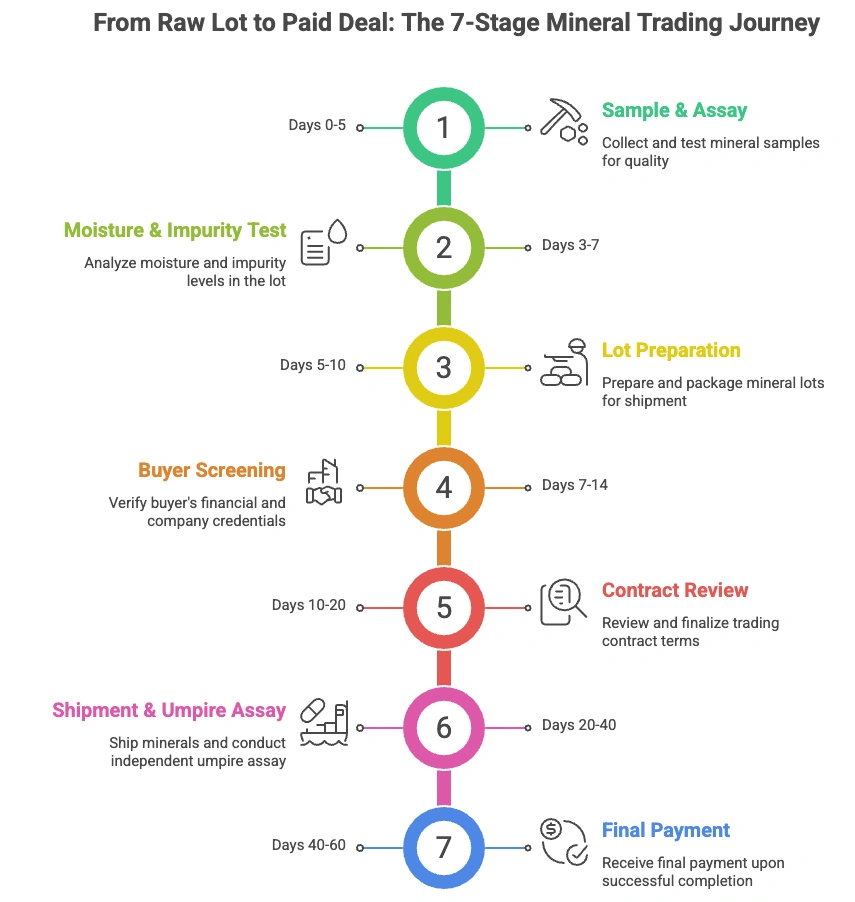
Before accepting any offer, take seven verification steps: confirm the assay and sampling method, check the moisture basis, demand the full pricing formula, verify the buyer’s banking details, clarify delivery terms, require a written payment schedule, and archive every revision. A one-day check can save months of dispute – and the verification process is simple if you know what to look for.
The Pre-Acceptance Checklist
Before you accept any offer on a tin or tantalum lot, confirm the assay, sampling method, and moisture basis. Ask for the full pricing formula, not just a top-line number. Check whether penalties or treatment charges apply. Verify the buyer’s company details and banking route. Clarify delivery point, title transfer, and who pays freight. Require a written payment schedule tied to clear milestones. Keep copies of all emails, reports, and revised terms. If one side keeps changing the process, stop and reassess. Good deals usually become clearer as they move forward. Bad deals usually become more confusing.
Strong Sellers Win on Preparation, Not Volume
Selling tin and tantalum well is less about finding the loudest buyer and more about presenting a credible lot, understanding the pricing formula, and refusing weak payment terms. Assay quality, moisture, impurities, and minimum parcel size shape the real outcome. So do contract details. For South African sellers who want a steadier route into mineral trading, working with a local partner such as South Group Recycling can make sense when you need support with testing, buyer screening, and practical transaction flow.
The market conditions in 2026 favour prepared sellers. Tin has broken through record price levels, and the International Tin Association projects global tin demand to grow roughly 25% by 2035, with tantalum demand rising alongside 5G and EV growth. Demand across the critical minerals complex is structurally strong, and the sellers who win in this environment are the ones who show up with clean paperwork, realistic expectations, and partners who can move a deal from conversation to payment without surprises.
Ready to Sell Your Tin, Tantalum, or Other High-Value Minerals?
Get practical mineral trading support from a specialist with over 10 years of experience across 16 African countries. We operate in Johannesburg, Cape Town, Pretoria, and Durban.