
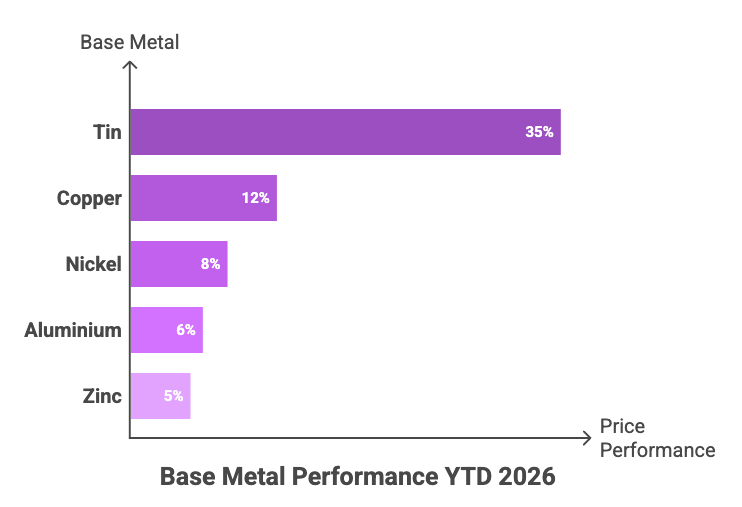
Tin prices smashed through previous records in January 2026, reaching an astonishing $53,400 per tonne on the London Metal Exchange. This dramatic surge represents a 35% gain since the start of the year and a staggering 75% increase compared to the same period in 2025. For investors and traders exploring mineral trading opportunities, understanding the forces behind this rally has never been more critical.
The tin market finds itself caught between explosive demand from the artificial intelligence revolution and chronic supply disruptions that show no signs of easing. This perfect storm has transformed tin from a traditional industrial metal into one of the most sought-after commodities of the decade.
What Is Driving Tin Prices in 2026?
Three interconnected factors are pushing tin prices to unprecedented levels: semiconductor industry expansion, renewable energy deployment, and severe supply constraints. Each element feeds into the others, creating a self-reinforcing cycle of tightening availability and escalating prices.
According to research published by the World Bank’s Commodity Markets Outlook, base metal prices including tin are expected to strengthen through 2027 due to persistent supply constraints and accelerating demand from clean energy technologies. Their analysis highlights that market deficits will continue tightening as new mining projects fail to keep pace with consumption growth.
The AI and Semiconductor Boom
Tin serves as the backbone of modern electronics through its essential role in soldering. Every circuit board, semiconductor chip, and electronic connection relies on tin-based solder to function. The explosive growth of data centres, driven by artificial intelligence applications, has sent tin demand soaring to levels that analysts never anticipated.
Major technology companies have pledged hundreds of billions of dollars toward data centre construction across the United States, Asia, and Europe. Each facility requires enormous quantities of tin for the countless solder connections that link processors, memory chips, and networking equipment.
Electric Vehicles and Renewable Energy
Modern electric vehicles contain over 3,000 individual solder points in their battery management systems alone, further amplifying demand. The International Tin Association projects that global tin demand will increase by 25% by 2035, cementing the metal’s status as a critical commodity for the energy transition.
This growth trajectory places tin alongside other strategic minerals essential for building tomorrow’s technological infrastructure. Solar panel manufacturing and grid-scale battery storage systems rely heavily on tin-based components for reliable electrical connections.
How Severe Are Tin Supply Shortages?
Extremely severe. Global tin production faces disruptions on multiple fronts, with the two largest exporting nations implementing policies that dramatically reduce available supply.
Indonesian Export Restrictions
Indonesia, historically the world’s largest refined tin exporter accounting for 25-30% of global shipments, saw President Prabowo Subianto order the closure of 1,000 illegal tin mines in Sumatra during late 2024. Licensing delays and tighter export approvals have caused shipments to run 20-30% below normal levels, squeezing global availability.
Myanmar Production Collapse
Meanwhile, Myanmar’s critical Man Maw mine remains largely inactive following a resource audit that began in 2023. Infrastructure damage from a devastating earthquake compounded operational challenges, reducing output from the world’s third-largest tin producer. According to data from the U.S. Geological Survey, Myanmar holds approximately 700,000 tonnes of tin reserves representing 15% of global deposits, making any production disruption particularly significant for market stability.
Analyst Price Projections
Fitch Solutions’ BMI research unit raised their 2026 tin price forecast from $32,000 to $35,000 per tonne, citing ongoing supply issues that keep markets perpetually on edge. Current prices have already blown past that projection, demonstrating just how tight the market has become.
Global Tin Production Overview (2024-2026 Estimates)
Country/Region | Est. Output (tonnes) | Global Share | Supply Status |
China | 90,000 | ~25% | Declining reserves |
Indonesia | 65,000 | ~18% | Export restrictions |
Myanmar (Wa State) | 35,000 | ~10% | Disrupted |
Peru | 28,000 | ~8% | Stable |
Bolivia | 18,000 | ~5% | Growing |
Congo (DRC) | 20,000 | ~6% | Expanding |
Other Countries | 104,000 | ~28% | Mixed |
Source: International Tin Association, USGS Mineral Commodity Summaries 2025
The Reality of Tin Mining Operations
Beyond the statistics, tin mining involves complex operations across diverse regions. West Africa holds extensive tin resources, and countries like Nigeria continue contributing to global supply despite significant challenges. Understanding these ground-level realities helps explain why production growth remains constrained even as prices surge.
Strategic Minerals and the Green Energy Connection
Tin has earned recognition as a critical mineral in the United States, European Union, United Kingdom, and Australia. This designation reflects growing awareness that modern economies cannot function without reliable access to this versatile metal.
Solar and Battery Applications
The renewable energy sector consumes substantial quantities of tin through photovoltaic cell production. Thin-film solar panels require tin oxide coatings that provide electrical conductivity while remaining transparent to sunlight. Battery technologies increasingly incorporate tin-based anodes that offer superior energy density compared to conventional materials.
Related Critical Minerals
This intersection of technology and sustainability creates compelling opportunities for those engaged in rare earth minerals trading. Just as Lithium powers electric vehicle batteries and Beryllium enables aerospace applications, tin occupies an irreplaceable position in electronics manufacturing. Understanding these material dependencies helps traders identify emerging opportunities across the entire critical minerals spectrum.
Will Recycling Ease Tin Supply Pressures?
Recycled tin currently meets approximately 30% of U.S. demand, up from 22% in 2020, demonstrating significant progress in secondary production. However, this growth rate cannot compensate for primary supply disruptions affecting the global market.
Urban Mining Opportunities
The concept of urban mining offers promising pathways for recovering valuable metals from electronic waste, yet scaling these operations takes years of investment and infrastructure development. The U.S. Department of Defense recently awarded $19 million to establish a tin smelting, refining, and recycling facility in Pennsylvania, signalling government recognition of supply chain vulnerabilities.
Circular Economy Initiatives
Recycling efforts connect directly with broader catalytic converter recycling programmes that recover precious and strategic metals from end-of-life vehicles. These circular economy approaches represent important steps toward supply security, even though they cannot fully replace primary production in the near term.
What Should Traders Expect for the Rest of 2026?
Market analysts expect continued volatility with an upward bias throughout 2026. The combination of structural supply deficits and accelerating demand from technology sectors creates conditions where sharp price movements remain likely.
LME Stock Levels and Investor Sentiment
LME warehouse stocks remain at critically low levels, leaving the market highly sensitive to any supply disruption or demand surge. Chinese investors have piled into tin positions throughout early 2026, adding speculative momentum to fundamentally driven price increases. This combination of physical tightness and investor enthusiasm suggests that current elevated prices may persist longer than skeptics anticipate.
Partnering with Trusted Suppliers
For those looking to capitalise on these dynamics, partnering with established South Group Recycling provides access to global trading networks and market expertise. Navigating volatile commodity markets requires reliable partners who understand both the technical fundamentals and trading practicalities involved in successful mineral transactions.
Positioning Your Mineral Trading Strategy
The tin price surge exemplifies broader trends reshaping commodity markets as green energy and technological advancement drive unprecedented demand for strategic materials. Traders who position themselves ahead of these shifts stand to benefit from structural market changes that will persist for decades.
South Group Recycling maintains relationships with trusted suppliers across South Africa, the UAE, United Kingdom, and beyond, facilitating mineral trade for clients seeking reliable counterparties in uncertain times. Our expertise spans the complete spectrum of strategic minerals, from base metals like tin to precious metal recovery from industrial sources.
Whether you hold tin-bearing materials seeking buyers or require supply for manufacturing operations, connecting with experienced traders eliminates the friction and uncertainty that can undermine profitability in fast-moving markets. The current environment rewards those who act decisively while others hesitate.