

South Africa is tightening anti-theft legislation and export controls on catalytic converters in 2026, reshaping who can buy, sell, and export these PGM-rich components. This guide explains the key regulatory changes, how they affect workshops, scrap yards, and individual sellers across the country, and why the new rules actually benefit anyone selling converters through legitimate channels.
Key Takeaways
- South Africa is tightening anti-theft legislation and export controls on catalytic converters in 2026
- The Second-Hand Goods Act (Act 6 of 2009) places stricter obligations on workshops, scrap yards, and dealers handling converters
- Export rules are being enforced more aggressively – affecting cross-border trade with Botswana, Namibia, and Zimbabwe
- Legitimate sellers benefit: tighter rules push more volume toward licensed buyers offering fair, assay-based pricing
- Platinum group metal prices have surged – platinum hit record highs above $2,400/oz in late 2025, with analysts forecasting continued strength
- South Group Recycling operates as a fully compliant, licensed buyer across Johannesburg, Cape Town, Pretoria, and Durban
Stricter enforcement of the Second-Hand Goods Act, new provincial policing initiatives, and tighter export permit requirements are making it significantly harder for stolen catalytic converters to enter South Africa’s supply chain. For workshops, scrap yards, and individual sellers, this means more compliance obligations – but also better catalytic converter prices and fairer valuations. More material is flowing to licensed recyclers like South Group Recycling, who use lab assay to price converters based on actual PGM content rather than guesswork. With platinum group metals (PGMs) – the precious metals inside every converter – reaching multi-year highs, the timing could not be better for legitimate sellers.
Why Is South Africa Cracking Down on the Catalytic Converter Market?
South Africa is cracking down because a surge in catalytic converter theft – fuelled by record-high platinum group metal prices – has turned the country into one of the world’s biggest hotspots for converter crime, forcing government to strengthen legislation and enforcement.
The Theft Epidemic: Fast Money, Easy Targets
Converter theft is rising because these components are worth thousands of rands in precious metals and can be stolen in under two minutes.
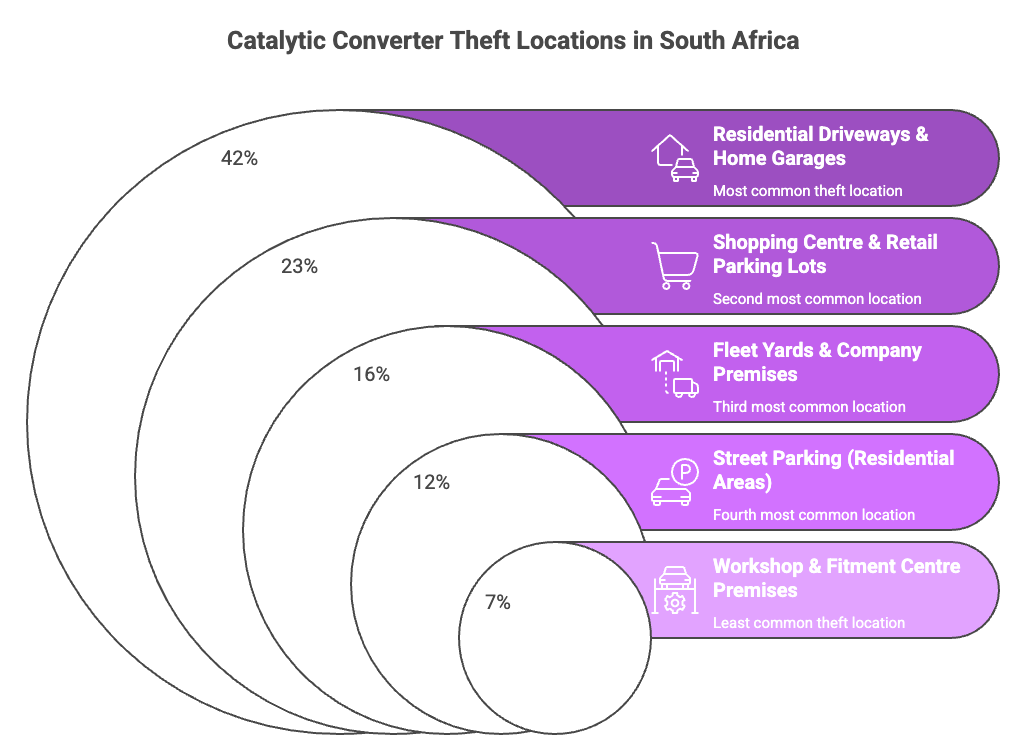
The catalytic converter theft surge is driven by the extraordinary value of the platinum, palladium, and rhodium inside each unit. A single converter can contain PGMs worth R5,000 to R25,000 or more, and a thief armed with a battery-powered saw needs less than two minutes to remove one. Vehicles like the Toyota Hilux, Fortuner, and Land Cruiser are primary targets because of their high ground clearance and valuable converter content.
PGM Prices Are Surging – And So Are Theft Incentives
Yes, PGM prices have surged dramatically, with platinum up over 90% and rhodium more than doubling – making converter theft profitable again. According to the World Platinum Investment Council (WPIC), platinum prices passed $1,900 per ounce by December 2025 and reached record levels above $2,400/oz. Bank of America Securities Global Research raised its 2026 platinum forecast to $2,450/oz, citing persistent supply deficits and constrained South African mine output. Rhodium, the most volatile of the three PGMs, more than doubled from its 2024 lows to above $10,000/oz by early 2026. Data from the Minerals Council South Africa shows that South African PGM production declined 4.4% in 2025, underlining the supply constraints driving prices higher. These price recoveries have reignited the economics that drive catalytic converter theft globally.
South Africa’s Unique Position: Producer and Target
South Africa is both the world’s largest producer of platinum group metals and one of the biggest targets for converter theft syndicates. The country produces approximately 70% of the world’s platinum and 80% of its rhodium, making it the source of these metals and simultaneously a prime target. According to South Group Recycling, converters from popular South African vehicles like the Hilux and Fortuner consistently rank among the highest-value units processed at their facilities. A SARS Customs media release confirmed the interception of catalytic converters and crushed PGM powder valued at R21 million at OR Tambo International Airport in 2022, destined for Dubai, the United Kingdom, and Jordan. Intelligence from the TAPA EMEA Intelligence System confirms that converter theft reports have been rising across South Africa, France, Germany, and the United Kingdom. Replacement costs for victims range from R15,000 to R60,000 or more per vehicle – a burden that falls hardest on working South Africans who depend on their vehicles daily.
A Continental Problem, Not Just a South African One
Catalytic converter theft is not limited to South Africa – it is a growing crisis across the African continent and beyond. Cities from Nairobi to Lagos face similar challenges, and South Africa’s regulatory response is being watched closely as a potential model for the continent. Which African cities are most affected by catalytic converter theft? That is a question with an increasingly complex answer as PGM prices climb.
What Are the Key Anti-Theft Rules That Workshops and Scrap Yards Must Follow in 2026?
Workshops and scrap yards must register with SAPS as second-hand goods dealers, verify every seller’s identity, keep detailed transaction records, and make those records available for police inspection – all under the Second-Hand Goods Act (Act 6 of 2009), which is now being enforced more aggressively than ever.
The Second-Hand Goods Act: Your Core Compliance Framework
The Second-Hand Goods Act (Act 6 of 2009) is the primary legislation governing the purchase and sale of catalytic converters in South Africa. It requires every dealer and recycler to be registered with SAPS, hold a valid licence, and maintain transaction records that can be inspected at any time. Enforcement has intensified, with provincial task teams in Gauteng, the Western Cape, and KwaZulu-Natal actively targeting converter theft syndicates and non-compliant dealers.
What This Means for Workshops and Fitment Centres
Every catalytic converter removed from a vehicle in a workshop must now be documented, and selling to unlicensed buyers can result in criminal charges. For workshops, exhaust fitment centres, and mechanics in Johannesburg, Cape Town, Durban, and Pretoria, the penalties for non-compliance include both fines and imprisonment. Understanding how catalytic converters fit into the broader recycling education in automotive engineering ecosystem is becoming essential for anyone operating in the automotive aftermarket.
2026 Compliance Requirements at a Glance
The table below summarises the five core compliance requirements that every workshop, scrap yard, and recycler handling catalytic converters must meet under the Second-Hand Goods Act.
| Requirement | Who It Applies To | What You Must Do | Penalty If Non-Compliant |
|---|---|---|---|
| SAPS Dealer Registration | Any business buying or selling converters commercially | Register as a second-hand goods dealer with SAPS; obtain and display a valid licence | Fines and/or imprisonment |
| Seller ID Verification | All registered dealers and recyclers | Verify and record the identity of every person selling a catalytic converter – no exceptions | Fines and/or imprisonment; licence revocation |
| Transaction Records | All registered dealers and recyclers | Record seller details, vehicle information, converter description, date, and price for every transaction | Fines and/or imprisonment |
| Record Retention | All registered dealers and recyclers | Retain all transaction records for the prescribed period and keep them accessible for police inspection | Fines and/or imprisonment |
| Recycler Registration | Any business that melts, smelts, shreds, or processes converters | Register separately as a recycler in addition to dealer registration | Fines and/or imprisonment; licence revocation |
Closing the Compliance Gap: Guidance for Workshops and Scrap Yards
The biggest challenge for most workshops and scrap yards is not willingness to comply – it is a lack of clear, practical guidance on implementation. Many legitimate owners want to follow the rules but are unsure of the exact steps. As outlined by South Group Recycling, working with a licensed recycler who already maintains full compliance can simplify the process significantly. Our full 2026 compliance checklist for South African workshops breaks down each obligation into actionable steps. Similarly, scrap yards face heightened scrutiny on provenance documentation – how scrap yards can prove their catalytic converters are legit is becoming a critical operational question.
How Are Stricter Export Controls Changing Cross-Border Catalytic Converter Trade?
Stricter export controls are reducing the flow of unregulated catalytic converters out of South Africa, shutting down smuggling routes to neighbouring countries, and pushing more PGM-bearing material into the regulated domestic recycling channel.
The Regulatory Framework: Precious Metals Act and Customs Duties
Two major pieces of legislation form the backbone of South Africa’s export control regime for catalytic converters. Export duties on scrap metals, introduced under the Customs and Excise Act in 2020 and extended multiple times since, work alongside the Precious Metals Act (Act 37 of 2005) administered by the Department of Mineral Resources and Energy, which requires export permits for precious metals and sets strict provenance documentation standards. Together, they make it significantly harder to move converter material across borders without proper authorisation.
How Smuggling Networks Operate – and How They’re Being Shut Down
Stolen catalytic converters have been routed through sophisticated international networks – crushed into powder, concealed in metal drums, and shipped to refining hubs in the UAE, UK, and Asia. South Africa’s position as the world’s dominant PGM producer means that its export controls have ripple effects across the continent. Trade corridors with Botswana, Namibia, Zimbabwe, and Mozambique are particularly affected. As documented in a SARS Customs media release, the R21 million seizure at OR Tambo in 2022 – where crushed converter powder was concealed in metal drums bound for Dubai, the UK, and Jordan – was one of the most high-profile interceptions to date. Stricter enforcement is designed to shut down these channels permanently.
Key Export Regulations and Affected Trade Routes
The table below outlines the three main regulatory mechanisms controlling catalytic converter exports from South Africa and the specific trade corridors they affect.
| Regulation | What It Requires | Affected Trade Routes | Market Impact |
|---|---|---|---|
| Precious Metals Act Export Permits | Export approval from the SA Diamond and Precious Metals Regulator; provenance documentation; SAPS forensic profiling for PGM-bearing materials | All international exports, with particular focus on SA → UAE, SA → UK, SA → East Asia routes | Reduces illegal PGM outflows; channels material to licensed domestic recyclers |
| Scrap Metal Export Duties | Export duties under the Customs and Excise Act; periodic export bans on ferrous and non-ferrous scrap | SA → Botswana, SA → Namibia, SA → Zimbabwe, SA → Mozambique corridors | Increases domestic scrap availability; supports local beneficiation |
| SARS Customs Enforcement | Physical inspection and interception of PGM-bearing materials at airports and border posts; detector dog units | OR Tambo International, Beit Bridge, Lebombo/Ressano Garcia, other key border crossings | Deters smuggling; high-profile seizures send a strong deterrent signal |
What This Means for Licensed Cross-Border Operators
Licensed operators can still trade catalytic converters across borders legally – the paperwork burden is real but manageable with the right processes in place. South Group Recycling, operating across 16 African countries, is well positioned to help businesses navigate cross-border compliance requirements. Dealers in neighbouring countries can learn more about the company’s cross-border capabilities through South Group Recycling. How South Africa’s catalytic converter rules affect trade across Africa is a growing topic of interest for recyclers who depend on SA as a refining hub.
What Do the New Rules Mean for Catalytic Converter Prices and Legitimate Sellers?
The new rules are good news for legitimate sellers. Tighter regulations are squeezing out informal, theft-linked buyers and pushing more volume to licensed recyclers – which means better prices, fairer valuations, and a safer marketplace for anyone selling through legal channels.
More Volume to Licensed Recyclers = Better Prices for Legal Sellers
When informal buyers are cut off from the supply chain, more material flows to licensed operations that compete on transparent, assay-based pricing rather than on willingness to ignore provenance questions. This shift in market dynamics directly benefits legitimate sellers who previously had to compete with rock-bottom prices offered by shady operators buying stolen stock.
A Double Tailwind: Regulation Meets Recovering PGM Prices
Sellers are benefiting from two simultaneous tailwinds: tighter regulation channelling more supply to licensed buyers, and a strong recovery in PGM prices. As covered in a recent analysis by South Group Recycling, PGM prices are recovering strongly – platinum surged past $2,400/oz in late 2025, palladium is trading above $1,100/oz, and rhodium has more than doubled from its 2024 lows. As reported by Mining Weekly, Bank of America Securities projects platinum to average $2,450/oz in 2026, supported by persistent supply deficits. South African mine output declined approximately 5% year-on-year through October 2025, according to the Minerals Council South Africa, and recovery is expected to be gradual. For sellers, this means the PGMs inside your old converter are worth significantly more than they were a year ago.
Why Assay-Based Pricing Matters More Than Ever
Assay-based pricing matters because it measures the actual platinum, palladium, and rhodium content in your specific converter – unlike flat “per unit” pricing, which can undervalue your converter by 30-60%. Catalytic converter prices in South Africa range from approximately R500 for low-PGM small cars to R25,000 or more for high-PGM SUVs, trucks, and hybrids. The difference between what a licensed recycler pays and what an informal buyer offers can be substantial, because informal operators estimate by eye rather than measuring actual PGM content through XRF analysis (X-ray fluorescence, a technology that identifies metal composition) or lab assay. As detailed by South Group Recycling, accurate valuation starts with scientific measurement, not guesswork.
Licensed Recycler vs Informal Buyer: Side-by-Side Comparison
The difference between selling to a licensed recycler and an informal buyer comes down to pricing accuracy, legal protection, and compliance. Here is how the two compare across six key factors.
| Factor | Licensed Recycler (e.g. South Group) | Informal / Unlicensed Buyer |
|---|---|---|
| Pricing Method | XRF analysis and lab assay – measures actual PGM content per converter | Visual estimate or flat “per unit” pricing – no scientific measurement |
| ID Required | Yes – mandatory under Second-Hand Goods Act | Often not requested – a red flag |
| Written Receipt | Yes – full documentation of every transaction | Rarely provided |
| Legal Protection for Seller | Full paper trail protects the seller if questions arise later | No documentation means no protection |
| Typical Price Accuracy | Within 5-10% of true PGM value based on current spot prices | Often 30-60% below actual PGM value |
| Compliance With Law | Fully compliant – registered with SAPS, licensed, inspected | Often operating illegally – seller may face legal risk too |
Before accepting any cash offer, there are important questions every South African should ask before selling a converter for cash in 2026. The new regulatory environment makes due diligence not just smart, but essential.
How Can You Sell Your Catalytic Converter Legally and Get the Best Price in 2026?
Sell to a licensed, Second-Hand Goods Act compliant recycler who uses lab assay or XRF analysis to determine the actual PGM content in your converter. This is the single most important step to getting a fair price while staying on the right side of the law.
Step One: Verify Your Buyer Is Licensed
The first thing to check is whether the buyer is registered with SAPS as a second-hand goods dealer. Any legitimate buyer will have a licence number they can show you, and they will be transparent about how they price converters. If a buyer cannot produce a licence, walk away – you could be exposing yourself to legal risk by transacting with an unlicensed operator.
What to Expect From a Legitimate Transaction
A legitimate transaction involves ID verification, a written receipt, and pricing based on scientific analysis of your converter’s PGM content. Any legitimate catalytic converter buyers near me should be willing to show their licence and explain their pricing process. Expect to provide valid identification when you sell – this is a legal requirement, not a red flag. Legitimate buyers will issue a written receipt detailing the converter description, the price paid, and the date. Ask specifically whether the buyer uses XRF or lab assay to determine PGM content. If the answer is no, consider looking elsewhere – flat “per unit” pricing almost always undervalues your converter. For a breakdown of what to look for in a compliant buyer, visit South Group Recycling’s catalytic converter recycling page.
Why South Group Recycling Is Built for the New Regulatory Environment
South Group Recycling is a fully licensed, Second-Hand Goods Act compliant recycler with facilities in Johannesburg, Cape Town, Pretoria, and Durban – already operating at the compliance standard the new enforcement environment demands. With over 10 years of experience and operations spanning 16 African countries, South Group uses professional XRF analysis and assay-based pricing tied to current PGM spot rates. Collection services are available for qualifying orders, making the process convenient for workshops, scrap yards, and fleet operators managing bulk volumes. Whether you have a single converter from your own vehicle or a workshop accumulating units from routine exhaust work, the process is the same: transparent assessment, fair pricing, and full compliance documentation. Full details on how the process works are available on South Group’s catalytic converter recycling page.
The Market Is Cleaning Up – And That’s Good News
South Africa’s new anti-theft and export rules are not a burden for legitimate players – they are a market correction that rewards compliance, transparency, and professional catalytic converter recycling. With PGM prices at multi-year highs, stolen-goods channels being shut down, and enforcement intensifying across the country, legitimate sellers and licensed recyclers are in a stronger position than they have been in years.
From workshops in Gauteng to scrap yards in the Western Cape and KwaZulu-Natal, the message is clear: operate within the law, sell to licensed buyers, and you will get a fairer deal. The industry is professionalising, and South Group Recycling is proud to be part of that shift. To explore your options or get a quote, contact South Group Recycling today.