
Failed solar inverters and solar batteries are classified as electronic waste under South Africa’s national e-waste regulations (GNR 834 of 2013) and cannot be discarded in general waste, municipal skips, or at unlicensed scrap yards. In both Cape Town and Johannesburg, the legal requirement is to hand this equipment to a registered e waste recycling facility. South Group Recycling operates certified collection and processing facilities in both cities, with a convenient book-a-collection service available online for households and businesses of all sizes.
Key Takeaways
- Failed solar inverters and batteries are legally classified as e-waste under GNR 834 of 2013 – they cannot go to general landfills, skip bins, or unlicensed scrap dealers.
- In both Cape Town and Johannesburg, South Group Recycling accepts solar inverters, lithium-ion batteries, lead-acid batteries, and full panel systems for certified, compliant disposal.
- Lead-acid solar batteries contain 12-15 kg of lead per unit – a Schedule 3 hazardous substance that leaches into groundwater if improperly discarded.
- Damaged or swollen lithium-ion batteries present a thermal runaway risk. Contact a certified e waste recycling operator before attempting to move them.
- Unlicensed scrap dealers strip metals and illegally discard the toxic components – placing legal liability on the household or business that handed the waste over.
- A waste transfer note issued by a certified recycler is the documentation that protects you from legal liability. Always request one.
- Businesses can face fines of up to R10 million under NEMWA for non-compliant disposal of classified hazardous waste.
- South Africa’s load-shedding solar boom means end-of-life equipment volumes will grow sharply through 2026 and beyond – proper electronic waste recycling infrastructure is available now and should be used before volumes overwhelm informal channels.
What Is Solar E-Waste and Why Is South Africa’s Load-Shedding Boom Creating a Disposal Crisis?
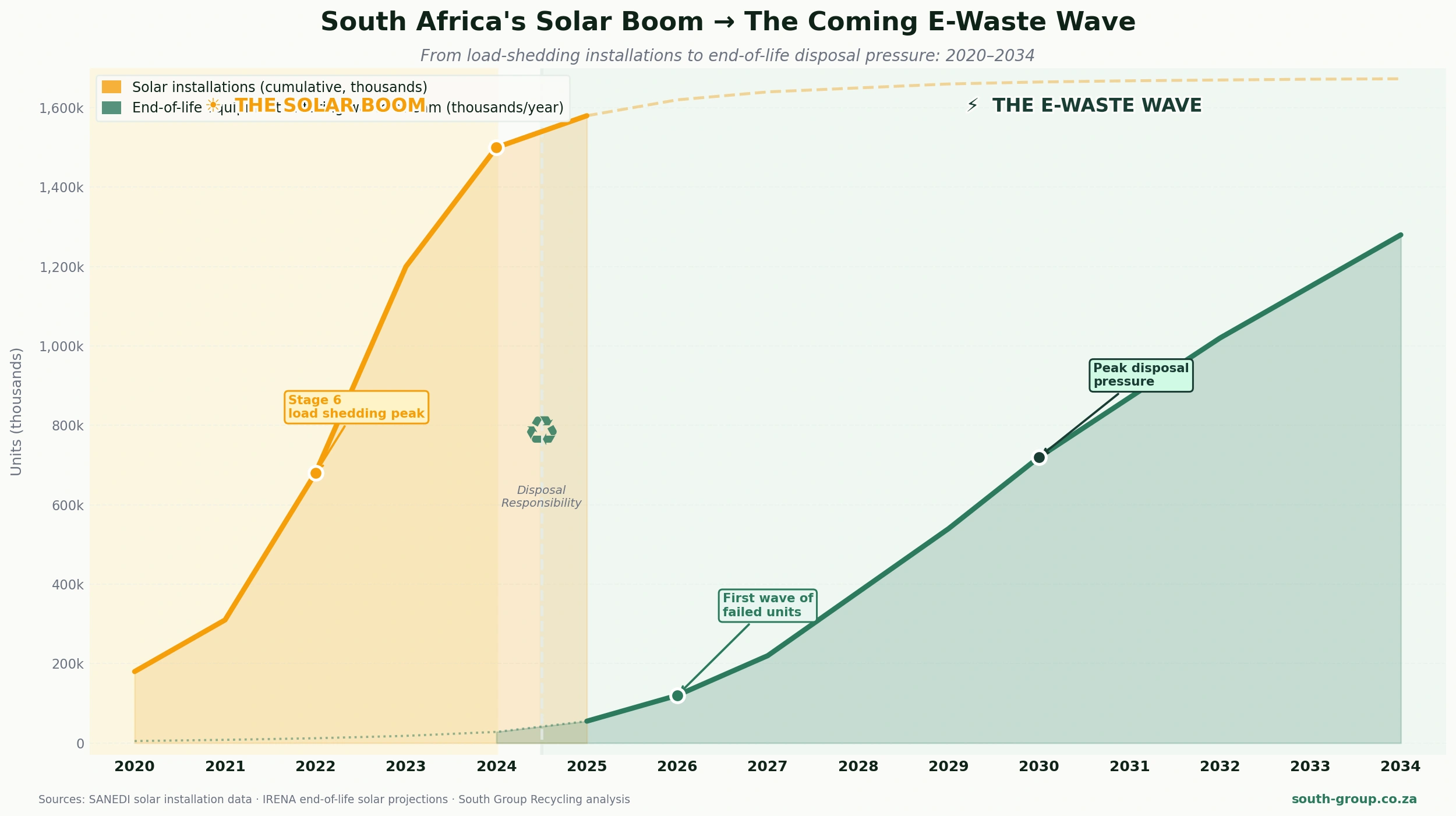
Solar e-waste is the fastest-growing category within South Africa’s already significant electronic waste stream. Between 2022 and 2024, load shedding drove an estimated 1.5 million new solar installations across residential and commercial properties nationwide – a rapid energy transition that reduced dependence on Eskom but has quietly set the stage for a large volume of end-of-life equipment in the years ahead.
How Long Do Solar Inverters and Batteries Actually Last?
Solar equipment does not last indefinitely. A typical lithium-ion solar battery carries a working lifespan of 8-12 years under normal cycling conditions, while lead-acid batteries in off-grid systems commonly need replacement every 3-5 years. Solar inverters – the electronic units that convert DC power from panels into usable AC current – have a rated life of 10-15 years, though many fail earlier due to sustained heat exposure, voltage surges from load shedding switches, or component defects. The first wave of systems installed at the height of Stage 6 load shedding in 2022 is already producing failed units.
Why load shedding shortens equipment life
Repeated switching between grid power and solar during active load shedding events places abnormal stress on inverter electronics and battery charge management systems. Many residential inverters installed during the 2022-2023 peak were operating at or near rated capacity for extended periods – conditions that accelerate thermal degradation in capacitors and reduce the effective cycle count of battery cells. Some households are already on their second inverter within three years of initial installation.
The Global Scale of the Solar E-Waste Problem
The global context makes this urgency clearer. According to the UN Global E-Waste Monitor, the world generated 62 million tonnes of e-waste in 2022 – and volumes are growing at approximately 2.6 million tonnes per year. Africa formally recycles less than 1% of its e-waste. South Africa is the continent’s most developed formal ewaste recycling market, but solar equipment remains an emerging blind spot in the collection infrastructure. As a result, many households and businesses are making disposal decisions without knowing the legal requirements or the environmental consequences. To understand why this matters at a human level, read our in-depth post on why e-waste is a growing global concern.
The regulations are clear and the solutions are accessible. What follows is a city-specific guide to getting this right.
How Do I Dispose of a Broken Solar Inverter in Cape Town in 2026?
In Cape Town in 2026, a broken solar inverter must be handed to a registered electronic waste recycling facility – it cannot legally be placed in general waste, donated to an unlicensed scrap dealer, or dropped at a municipal landfill site.
What Is Actually Inside a Solar Inverter?
Understanding what is inside an inverter explains why this rule exists. A typical residential grid-tied inverter contains printed circuit boards (PCBs) carrying lead solder and brominated flame retardants, electrolytic capacitors filled with chemical compounds, copper windings in its transformer, aluminium heatsinks, and in some power semiconductor modules, small amounts of beryllium oxide. These materials are classified as hazardous electrical and electronic equipment (HEEE) under South Africa’s National Environmental Management: Waste Act (NEMWA, Act 59 of 2008) and the specific e-waste regulations GNR 834 of 2013 published by the Department of Forestry, Fisheries and the Environment (DFFE).
Key hazardous components at a glance
The PCB is the most hazardous element in any inverter – it contains lead solder joints throughout, brominated flame retardants in the board substrate itself, and in higher-voltage designs, a small quantity of beryllium oxide in ceramic insulating pads. None of these compounds belong in a landfill or in the hands of an operator without proper chemical handling facilities.
The Step-by-Step Disposal Process in Cape Town
The disposal process is straightforward. Contact South Group Recycling to arrange a drop-off at the Cape Town facility, or for households without suitable transport, book a collection from your property online. Upon handover, a certified recycler will issue a waste transfer note – the official document that records the legal transfer of hazardous waste. This paperwork is increasingly important for businesses required to demonstrate environmental compliance in ESG reporting or supplier audits.
South Group Recycling accepts inverters of all sizes at its Cape Town facility – from small 1 kVA residential units to large commercial multi-phase systems. No appointment is required for drop-offs during operating hours, though booking a collection in advance is the most convenient option for heavier units or multiple pieces of equipment.
Where Can I Drop Off Old Solar Batteries in Cape Town Safely?
Old solar batteries – whether lithium-ion or lead-acid – can be dropped off safely in Cape Town at certified e waste recycling facilities, with South Group Recycling accepting both battery types for compliant processing and regulated material recovery.
The key distinction every Cape Town household must understand is that solar battery types carry fundamentally different risks in disposal – and neither type belongs in a skip bin or at a general landfill.
Lead-Acid Solar Batteries: The Heavy Metal Risk
Lead-acid solar batteries – the older, heavier chemistry commonly used in off-grid and hybrid setups – contain 12-15 kg of lead per unit, classified as a Schedule 3 hazardous substance under South African law. A cracked or punctured lead-acid unit can leach sulfuric acid and soluble lead compounds into soil within days of improper storage. These must not be handed to unlicensed cash-for-scrap collectors, who typically lack the handling equipment to prevent spills and will not issue compliant waste documentation.
What makes lead-acid batteries so dangerous when improperly disposed of
Lead is a persistent environmental toxin with no safe threshold in soil or drinking water. A single improperly discarded lead-acid battery can contaminate up to 600 litres of groundwater. In Cape Town’s Western Cape context, where several communities rely on borehole water supplemented by municipal supply, this risk is not theoretical – it is a documented environmental hazard associated with the growth of informal battery recycling operations across the Cape Flats.
Lithium-Ion Solar Batteries: The Thermal Runaway Risk
Lithium-ion solar batteries – including the LiFePO4 chemistry used in popular home storage systems – present a different category of risk: thermal runaway. A mechanically damaged or internally faulted lithium cell can spontaneously ignite, producing a fire that is extremely difficult to extinguish with standard methods. If your battery is visibly swollen, physically cracked, has experienced a fault warning, or is unusually hot to the touch, do not attempt to transport it without guidance. Contact South Group Recycling directly to arrange safe removal.
Signs your lithium battery may be compromised
Visible swelling or bulging of the battery casing, excessive heat during or after charging, a persistent burning or chemical smell near the unit, unusual sparking during connection, or any fault code reading from the battery management system are all indicators that the battery has sustained internal damage. Do not attempt to move, discharge, or dismantle a battery showing these signs without specialist assistance.
| Battery Type | Key Hazardous Materials | SA Legal Classification | Primary Disposal Risk | Accepted by South Group? |
|---|---|---|---|---|
| Lead-Acid (flooded, sealed, AGM) | Lead (12-15 kg/unit), sulfuric acid electrolyte | Schedule 3 Hazardous Substance | Soil and groundwater leaching | Yes |
| Lithium-Ion (Li-NMC, LiFePO4) | Cobalt, nickel, manganese, lithium salts | HEEE under GNR 834 / NEMWA | Thermal runaway if damaged | Yes (contact first if damaged) |
Table 1: Solar battery types, hazardous content, and legal classification in South Africa.
The Value in What You Are Recycling
Both battery chemistries contain materials with genuine recovery value. Lead from lead-acid batteries achieves above 95% recovery rates in formal recycling systems globally. Lithium cells yield cobalt, nickel, manganese, and lithium salts – all in growing demand for new battery manufacturing. Recycling is not just a legal obligation; it is a practical contribution to South Africa’s circular economy.
Where Can I Recycle Lithium and Lead-Acid Solar Batteries in Johannesburg?
Both lithium-ion and lead-acid solar batteries can be recycled in Johannesburg through South Group Recycling, a licensed facility handling hazardous e waste streams in full compliance with South Africa’s National Environmental Management: Waste Act and the e-waste regulations under GNR 834.
Johannesburg is South Africa’s largest urban centre and has seen some of the highest solar adoption rates in the country, particularly across east and west rand suburbs where load shedding disruption was most severe. The resulting volume of ageing batteries entering the waste stream is growing steadily, making access to a compliant Johannesburg recycler more pressing with each passing year.
Lead-Acid Battery Recycling in Johannesburg
For lead-acid batteries, Johannesburg’s formal recycling process involves the neutralisation of the sulfuric acid electrolyte, followed by smelting of the lead plates into secondary lead ingots that re-enter manufacturing. This secondary lead carries a significantly lower carbon footprint than virgin lead production – a meaningful contribution to South Africa’s resource efficiency targets.
What the material recovery process looks like
At a certified facility, lead-acid batteries are first inspected and safely stored in acid-resistant containment. The electrolyte is drained and neutralised before the casing is cracked and the internal lead plates separated. Lead is then smelted at high temperature and cast into secondary ingots with a purity of 99.97% or above – material that re-enters the supply chain as refined secondary lead, reducing demand for environmentally damaging primary lead mining.
Lithium-Ion Battery Recycling in Johannesburg
Lithium battery recycling is more technically complex. South Group Recycling works with certified processing partners equipped for lithium chemistry, ensuring cells are fully discharged and safely dismantled before hydrometallurgical extraction of cobalt, lithium, and nickel. The importance of getting this right is significant: according to IRENA’s end-of-life solar equipment research, the global stock of solar PV equipment requiring end-of-life management will reach 78 million tonnes by 2050, with battery waste growing proportionally as storage becomes standard in solar installations across developing markets.
Materials recovered from lithium cells
A single lithium-ion battery module from a typical residential solar storage unit contains recoverable quantities of cobalt oxide, lithium carbonate, nickel sulphate, and manganese – all critical minerals for new battery cell manufacturing. As global supply chains for these materials come under increasing pressure, the recovered material from South Africa’s growing solar battery waste stream has tangible economic value alongside its environmental importance.
Businesses in Johannesburg managing multiple battery banks – warehouses, office parks, or schools that installed solar systems at scale during the load-shedding peak – can request a scheduled collection service. This removes the logistical burden of transporting heavy, regulated waste and ensures that waste transfer documentation is provided for each load.
How Do I Dispose of a Failed Solar Inverter in Johannesburg Without Breaking the Law?
To legally dispose of a failed solar inverter in Johannesburg, you must use a registered electronic waste recycling operator – discarding inverters in general waste, skips, or at unlicensed scrap yards violates the National Environmental Management: Waste Act (Act 59 of 2008) and carries fines of up to R10 million for businesses and the possibility of criminal prosecution for serious or repeat offences.
Why Unlicensed Scrap Dealers Are Not a Legal Option
A common misconception in Johannesburg is that handing a failed inverter to a general scrap dealer is an acceptable shortcut, given that inverters contain copper and aluminium with obvious resale value. The problem is that unlicensed dealers typically strip the recoverable metals and either burn or illegally landfill the remaining PCBs, plastic casings, and capacitors – the most hazardous components. This constitutes illegal disposal under NEMWA, and the environmental consequences of this practice are well documented in communities surrounding Johannesburg’s informal scrap trade, where soil contamination from PCB chemicals has been recorded in several areas.
The liability trap: why the original owner remains responsible
Under NEMWA’s extended producer and holder responsibility framework, the obligation to ensure lawful disposal does not end when you hand a hazardous item to an unlicensed third party. If an unlicensed dealer improperly disposes of an inverter you provided, the original holder of the waste can still face enforcement action – particularly where it can be shown that no formal waste transfer documentation was issued. This is why the waste transfer note from a certified recycler is not bureaucratic paperwork; it is the legal evidence that your obligation has been properly discharged.
| Disposal Route | Is It Legal? | Waste Transfer Note Issued? | Risk to Household / Business |
|---|---|---|---|
| Registered e-waste recycler (e.g. South Group Recycling) | Yes | Yes | None – fully compliant |
| Municipal landfill (general waste) | No | No | Violation of NEMWA / GNR 834 |
| Unlicensed scrap dealer | No | No | Fines up to R10 million for businesses |
| Skip bin / general rubbish removal | No | No | Liability for improper hazardous waste disposal |
Table 2: Legal status of common inverter disposal routes in Johannesburg and Cape Town.
The Correct Disposal Process: Step by Step
Contact South Group Recycling to confirm a drop-off or to book a collection from your Johannesburg address. Retain the waste transfer note issued at the point of handover. For commercial clients required to maintain ongoing compliance records – particularly those in sectors where ESG audits are standard – South Group Recycling can assist with waste management planning documentation beyond individual transactions.
Can I Send My Old Solar Panels and Inverters to a Landfill in Johannesburg or Cape Town, or Is It Banned in South Africa?
No – disposing of solar panels and inverters at a landfill in Johannesburg or Cape Town is prohibited under South Africa’s e-waste regulations, as they are classified as hazardous electrical and electronic equipment under GNR 834 of 2013, and sending them to a general landfill is a direct violation of both national law and South Africa’s international environmental obligations.
Why Solar Panels Cannot Go to Landfill
This is among the most common disposal misconceptions South African households hold. A municipal landfill site is not a legally acceptable destination for broken solar equipment, regardless of how it is packaged or labelled. The DFFE’s gazetted e-waste regulations explicitly list inverters, photovoltaic panels, and battery systems as restricted waste streams requiring management by registered facilities.
Crystalline silicon panels: the lead solder risk
Standard crystalline silicon panels – which make up the majority of residential installations across South Africa – contain lead solder at the cell interconnections running throughout the panel laminate. As panels degrade in a landfill environment over years and decades, rain and soil contact progressively dissolve these lead compounds, introducing them into groundwater. A residential installation of 10-20 panels can contain several hundred grams of lead solder in total.
Thin-film panels: the cadmium hazard
Thin-film photovoltaic panels – less common in residential use but present in some commercial installations – carry an additional and more acute risk. Cadmium telluride and copper indium gallium selenide, the active semiconductor compounds in these panels, are classified carcinogens. Landfilling thin-film panels is a serious environmental hazard and a clear violation of both SA e-waste regulations and the country’s obligations under the Basel Convention on transboundary hazardous waste.
South Africa’s International Legal Obligations
South Africa is a signatory to the Basel Convention on the Control of Transboundary Movements of Hazardous Wastes, the international framework governing how hazardous e-waste may be stored, moved, and disposed of. Landfilling classified hazardous e-waste contravenes both the national regulations and these international commitments. For a broader view of why these regulations matter globally, read our post on the human impact of e-waste.
If you have accumulated solar panels, inverters, or batteries that need to be removed from a property in Cape Town or Johannesburg, the legal and practical solution is ewaste recycling through a certified operator. South Group Recycling handles full solar system decommissioning – including panel dismantling, inverter processing, and battery recovery – across both cities, with collection available for properties where on-site removal is required.
Ready to Dispose of Your Solar Equipment Correctly?
Whether you have a single failed inverter or a full set of end-of-life solar batteries, South Group Recycling has the certifications, infrastructure, and experience to handle your solar e-waste legally and efficiently across Cape Town, Johannesburg, Pretoria, and Durban.