
Introduction: Old metal around the house or shop can still feel like junk. In 2026, many South Africans in Cape Town, Johannesburg, Durban and Pretoria are finding small piles of non-ferrous metal that sell for far more than expected. If you have searched for scrap yards near me, there is a good chance your hidden treasure is already sitting in a garage, back room, ceiling void, workshop bin, or renovation pile.
This article covers the 17 most overlooked non-ferrous items found in South African homes and small businesses, how to recognise copper, brass, and aluminium in seconds, which value band each item usually falls into, and how to sort a mixed load in under 10 minutes. You will also find practical guidance on legal selling, current 2026 pricing context, and how export market shifts are starting to influence local aluminium values.
Key Takeaways
- Copper, brass, and aluminium often hold more value than mixed metal loads.
- A simple magnet test helps you spot many non-ferrous items fast.
- Clean, sorted material usually lands in a better value band.
- Homes, solar installs, and small businesses all hide saleable metal.
- Air-cons, cables, taps, rails, and wheels are often overlooked.
- Sell legally, separate mixed parts, and keep proof of ownership.
Why is non-ferrous junk paying South Africans more attention in 2026?
Because many homes and small businesses now replace, repair, and clear out more electrical and building material than before. That leaves behind valuable copper, brass, and aluminium in places people rarely check.
According to the OECD, South Africa’s electricity sector remains a major policy and business focus. You can see that on the ground. Backup systems, rooftop solar parts, replacement wiring, and workshop upgrades have become common, and those changes create more leftover non-ferrous metal than many owners realise.
There is also an export angle to watch. The EU’s carbon border tax is reshaping how aluminium and several other metals are priced into 2026, and the effects are starting to filter through to what local yards pay for clean aluminium loads. For a closer look at this shift, see our breakdown of how the EU’s carbon border tax will change South Africa’s aluminium and scrap market in 2026.
What does non-ferrous mean in plain language?
It means metal with little or no iron in it. In simple terms, these metals often resist rust better, and many of them do not stick to a magnet.
Think of copper pipe, brass taps, and aluminium window frames. That is the easy way to picture ferrous and non-ferrous metals. Steel gates and cast iron pans are usually ferrous. Copper, brass, and aluminium are the common hidden treasures.
How can you recognise common non-ferrous metals quickly?
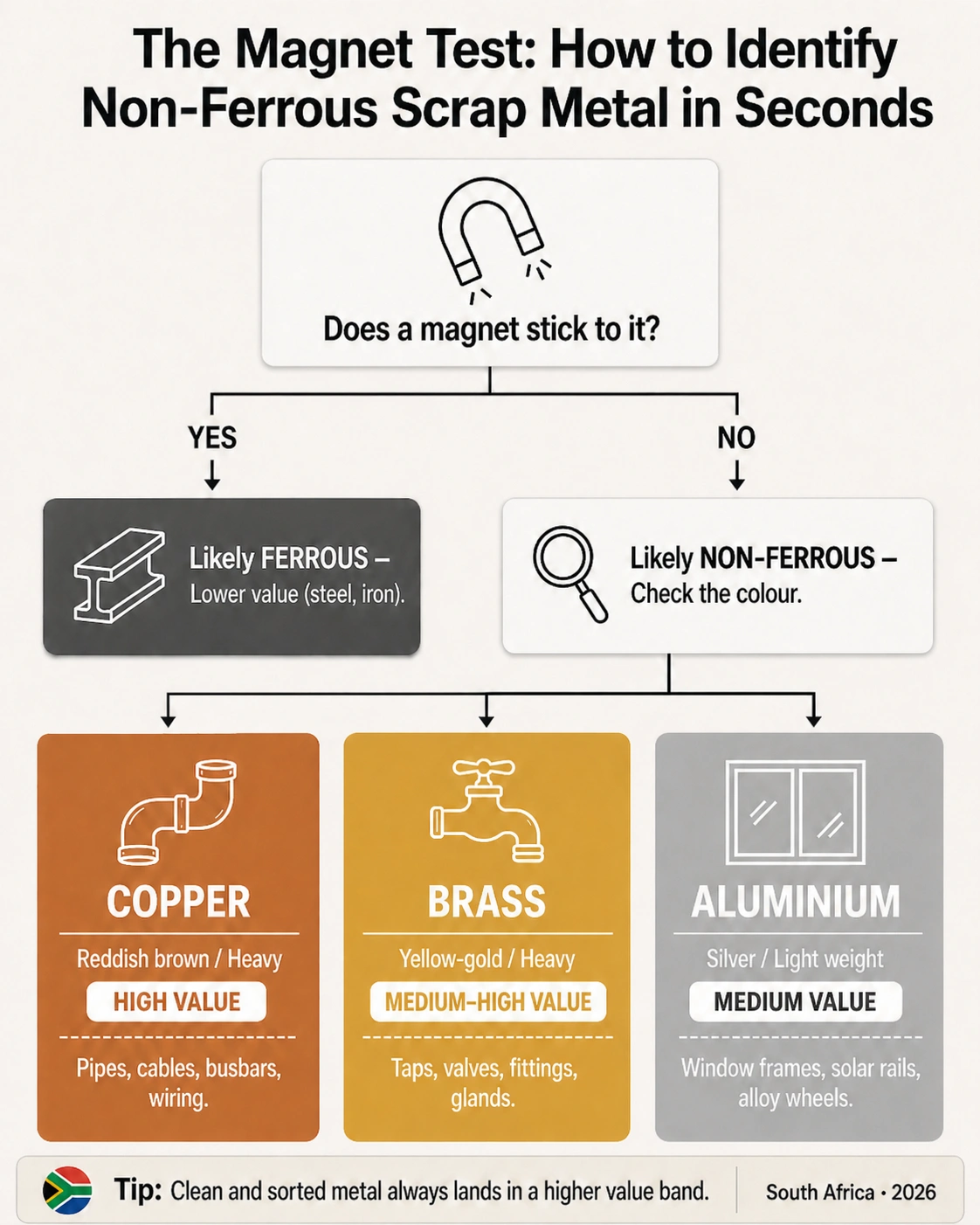
Use three clues: colour, weight, and a magnet. In many cases, that is enough for a fast first sort.
Copper usually looks reddish brown. Brass has a yellow-gold tone. Aluminium is silver in colour and feels light for its size. A magnet often will not stick to these metals, although screws, clips, and dirt can confuse the test. If a mixed item partly sticks and partly does not, take a closer look before throwing it in with steel.
Which signs help you tell copper, brass, and aluminium apart?
The signs are simple and easy to spot. Copper looks red-brown, brass looks yellow-gold, and aluminium looks silver and feels light.
The table below gives you a quick recognition guide for the most common non-ferrous metals found in homes and small businesses.
| Metal | Typical look | Magnet test | Common places |
|---|---|---|---|
| Copper | Reddish brown | Usually does not stick | Pipes, cables, coils, windings |
| Brass | Yellow-gold | Usually does not stick | Taps, valves, fittings, glands |
| Aluminium | Silver, light in weight | Usually does not stick | Window frames, rails, wheels, heat sinks |
| Mixed item | Several colours or coatings | Some parts may stick | Geysers, air-cons, electrical equipment |
Which hidden treasures show up during home renovations?
The best ones are often the bits left behind after plumbers, electricians, and builders finish. These pieces are small, easy to miss, and often better when kept separate from steel and rubble.
1. Are old copper plumbing pipes worth keeping?
Yes. Clean copper pipe usually sits in the high value band, and a magnet should not stick to the pipe itself.
Look behind removed sinks, in garage corners, or near bathroom renovation waste. Cut pipe, old elbows, and short lengths still count. Shake out sand or water, and keep copper away from plastic pipe and steel brackets.
2. Do brass taps and mixer bodies sell better than they look?
Usually, yes. Brass taps often fall in the medium to high value band, even when they look dull or worn.
The colour is your clue. Scratch a hidden spot and look for a yellow-gold tone. The magnet should not stick to the main body. Remove ceramic tops, rubber washers, and long steel screws if you can do so quickly.
3. Are brass stopcocks, valves, and water fittings worth separating?
Yes. Small brass fittings add up fast, and they are easy to sort into a clean brass pile.
You will find them on old plumbing lines, geyser connections, irrigation points, and outdoor hose setups. Value band is usually medium, sometimes high when the load is clean and heavy. Keep them out of mixed building rubble.
4. Are aluminium window frames worth the effort?
Yes, if you separate them well. Aluminium frames usually fall in the medium value band, and bulk makes a big difference.
Check old shopfronts, sliding doors, broken windows, and patio upgrades. The frame itself should not hold a magnet. Remove glass, rubber, sealant chunks, and steel screws where practical. Clean, bare frame pieces are easier to assess.
5. Should you keep old geyser elements and fittings?
Yes, but sort them carefully. The whole geyser is mixed, yet the brass fittings and some copper-bearing parts can hold value.
Do not assume the tank itself is your hidden treasure. Instead, look at the fittings, valves, and attached wiring. The value band ranges from low to medium for mixed parts and can improve when the non-ferrous pieces are separated from steel.
6. Are house wiring offcuts from rewiring jobs worth saving?
Yes. Copper offcuts from a rewiring job often sit in the high value band when they are clean and well sorted.
These short lengths pile up quickly in ceiling work, DB upgrades, and extension builds. A magnet should not stick to the copper conductor. Leave licensed electrical work to electricians, but keep legal offcuts and stripped ends in a container instead of sending them to general waste.
Which solar and backup leftovers sell better than they look?
Many backup and solar jobs create excellent non-ferrous leftovers. Thick cable, rails, busbars, and some internal metal parts are the main ones to watch.
7. Are thick copper battery and inverter cables valuable?
Yes. Thick copper cable is often one of the strongest hidden treasures in a backup power pile.
Look for heavy red and black cable from old battery banks, inverter replacements, and generator tie-ins. The copper inside is non-magnetic and usually high value when clean. Heavy insulation, burnt lugs, and mixed attachments can pull the value band down.
8. Do aluminium solar mounting rails have resale value?
Yes. Long, clean rails usually fall in the medium value band and are easy to recognise.
They are silver, light, and usually non-magnetic. You will see them when panels get repositioned, roofs are repaired, or mounting systems are replaced. Cut off steel bolts and keep the rails dry and stacked neatly.
9. Are copper busbars from changeovers and battery banks worth collecting?
Yes. Copper busbars can sit in the high value band because they are dense, clean, and easy to sort.
These flat copper bars often appear in battery cabinets, changeover boards, and larger inverter setups. The colour gives them away. Remove plastic covers where possible, but do not strip live or unsafe equipment.
10. Do brass cable glands, lugs, and heavy connectors matter?
Yes. Individually they look small, but together they can build a useful medium value pile.
Check old DB enclosures, backup cabinets, and workshop install leftovers. Some lugs are copper or aluminium, while many cable glands are brass. Test the main body with a magnet and keep steel nuts or washers in a separate container.
11. Are aluminium heat sinks from failed inverters and UPS units worth separating?
Sometimes. The aluminium heat sink itself can hold medium value, but the whole device may belong in a specialist e-waste stream first.
If the unit is still complete, boards and other components may need different handling, so it is best not to strip the device yourself. If the heat sink is already separated and clean, the magnet should not stick, and the light weight will make it easy to spot.
What non-ferrous items do small businesses and workshops often miss?
Air-con parts, refrigeration metal, cabinet offcuts, and wheels are common misses. Many SMEs focus on clearing space fast and lose money by tossing valuable metal into mixed waste.
12. Are old air-conditioner coils and pipes worth money?
Yes. Air-con units often contain copper and aluminium, and the coil section can be one of the better value items in a workshop clean-out.
The unit is mixed, so do not treat it as one simple metal type. Copper pipes are usually non-magnetic and higher band. Aluminium fins are lighter and usually medium band. Keep the unit legal, identifiable, and safely handled.
13. Do refrigeration coils from fridges and cold rooms count as hidden treasure?
Yes. They often do, especially in restaurants, convenience stores, and repair shops.
Look for condenser and evaporator sections with copper tubes and aluminium fins. Value usually lands in the medium band unless the copper is well separated. Make sure gas handling and equipment removal follow safe, lawful procedures.
14. Are electrical cabinet offcuts and panel parts worth sorting?
Yes. Small cabinet leftovers can hide copper bars, brass glands, and aluminium plates.
This is common after DB upgrades, machine rewiring, and control panel rebuilds. Steel cabinets themselves may dominate the weight, but the non-ferrous parts inside are often the real prize. Sort by type rather than tossing the whole lot together.
15. Do workshop cable offcuts still hold value if they are short?
Yes. Short pieces still add up, especially in electrical and maintenance shops.
Keep them dry and sort by thickness and type where possible. Thick copper cable usually lands high, while mixed or thin insulated wire may sit lower. If you are comparing buyers after a scrap metal near me search, sorted cable usually gives you a clearer outcome than a tangled mixed bag.
16. Are alloy wheels from tyre shops and garages worth selling?
Yes. Aluminium alloy wheels are a classic overlooked item and usually sit in the medium value band.
They are easy to identify by colour and weight, and a magnet should not stick to the wheel body. Remove tyres, valves, wheel weights, and heavy dirt where possible. Cracked or damaged wheels can still hold metal value.
17. Are old aluminium shop signs, frames, and display stands worth keeping?
Yes. These pieces are common in small businesses and often end up in skip bins by mistake.
Look at retail refits, office moves, and warehouse signage changes. The aluminium frame is usually light and non-magnetic. Vinyl, plastic, glass, and steel fasteners should come off if you want a cleaner load and a better value band.
Which items usually fall in the low, medium, or high value band?
Clean copper usually sits at the top, brass often follows, and aluminium tends to land in the middle. Mixed items usually drop lower unless you separate them first.
Exact metal scrapping prices move with grade, cleanliness, quantity, and the local market, so a value band is more useful than guessing a fixed number.
| Item | Usual value band | What helps |
|---|---|---|
| Copper plumbing pipes | High | Keep clean and separate from fittings |
| Brass taps | Medium to high | Remove rubber and steel parts |
| Brass valves | Medium to high | Group with other brass pieces |
| Aluminium window frames | Medium | Remove glass, rubber, and screws |
| Geyser fittings and elements | Low to medium | Separate non-ferrous parts from the tank |
| House wiring offcuts | High | Sort by thickness and cleanliness |
| Battery and inverter cables | High | Keep heavy copper cable in its own pile |
| Solar mounting rails | Medium | Remove steel bolts |
| Copper busbars | High | Keep flat bars clean and dry |
| Brass glands and connectors | Medium | Separate steel washers and nuts |
| Aluminium heat sinks | Medium | Remove electronic boards if already dismantled |
| Air-con coils and pipes | Medium to high | Sort copper from aluminium where lawful and safe |
| Refrigeration coils | Medium | Keep mixed coil sections together and clean |
| Electrical cabinet offcuts | Low to medium | Pick out copper and brass from mixed metal |
| Workshop cable offcuts | Medium to high | Sort thick cable from thin mixed wire |
| Alloy wheels | Medium | Remove tyres and dirt |
| Aluminium signs and display frames | Medium | Strip plastic and glass |
Value bands move week by week, and prices vary across grades, regions, and buyers. Before you take a load in, it pays to check current rates so your expectations match what yards are actually paying. For an up-to-date breakdown of which scrap metals are worth the most across South Africa right now, see our March 2026 price guide on ferrous vs non-ferrous scrap.
What should you do before you sell?
Sort the load, remove obvious non-metal parts, and sell only material you can lawfully own and move. Those three steps protect value and keep the process clean.
According to SAPS, South Africa regulates trade in second-hand goods to help combat stolen property. That matters for copper cable, fittings, air-con parts, and other materials that can raise red flags. Keep invoices, job cards, site clearance notes, or other proof when you can. No shortcuts, no questionable loads, and no stripped public infrastructure.
People who search scrap metal disposal near me often have a mixed pile that includes electronics, cables, metal frames, and damaged equipment. If your load includes boards, power devices, or full electronic housings, set those aside for a specialist e-waste handler rather than mixing them in with your sorted non-ferrous piles.
How do you sort a mixed load in 10 minutes?
Start simple. Build separate piles for copper, brass, aluminium, steel, and mixed electronic items.
- Use a magnet on the main body of each item.
- Group reddish copper pieces together.
- Group yellow-gold brass pieces together.
- Stack light silver aluminium pieces together.
- Remove plastic, rubber, glass, and loose steel when it is quick and safe.
- Set aside whole electronic units for separate handling.
Where do people in Cape Town, Johannesburg, Durban and Pretoria usually lose value?
They lose value by mixing good non-ferrous metal with steel, rubble, and plastic. They also lose value by selling dirty, wet, or unsorted loads.
This happens in homes, body shops, plumbing stores, tyre shops, and small factories. It is also common with non-ferrous metals in Cape Town, where renovation and shopfit waste builds up fast and gets cleared in a hurry. The same pattern shows up in Johannesburg, Durban and Pretoria. A little sorting often does more than people expect.
Summary
Non-ferrous hidden treasures are closer than most people think. In 2026, the easy wins often come from old pipes, brass fittings, cable offcuts, solar rails, air-con parts, alloy wheels, and shopfront aluminium. You do not need a huge industrial yard to find them. Many of the best items come from normal home repairs and everyday small business clean-outs.
If you want a straightforward route for mixed household or SME loads, book a non-ferrous collection in Cape Town, Johannesburg, Durban or Pretoria and ask about handling for scrap metal. Clean sorting, legal ownership, and clear separation between metal and e-waste will help you get more from what you already have.