
Catalytic converters are a quiet but powerful piece of modern vehicle technology. You rarely see them, you usually don’t think about them, and yet they play a major role in keeping city air cleaner. Every time a petrol engine runs, it creates exhaust gases that can contain toxic compounds. A properly working converter reduces those pollutants before they leave the tailpipe—helping lower smog, reduce irritation for people with respiratory issues, and support cleaner air in high-traffic areas.
In South Africa, catalytic converters also have another reality: they contain valuable platinum group metals (PGMs). That value makes end-of-life units worth money—especially when recycled responsibly. But because there’s real value in what’s inside, it also means you should handle used units carefully and work with a trusted recycler that understands compliance, safe processing, and accurate pricing.
If you want a clear, practical view of how the process works from collection to metal recovery, start with How Catalytic Converter Recycling Works (Step-by-Step).
What Does a Catalytic Converter Do?
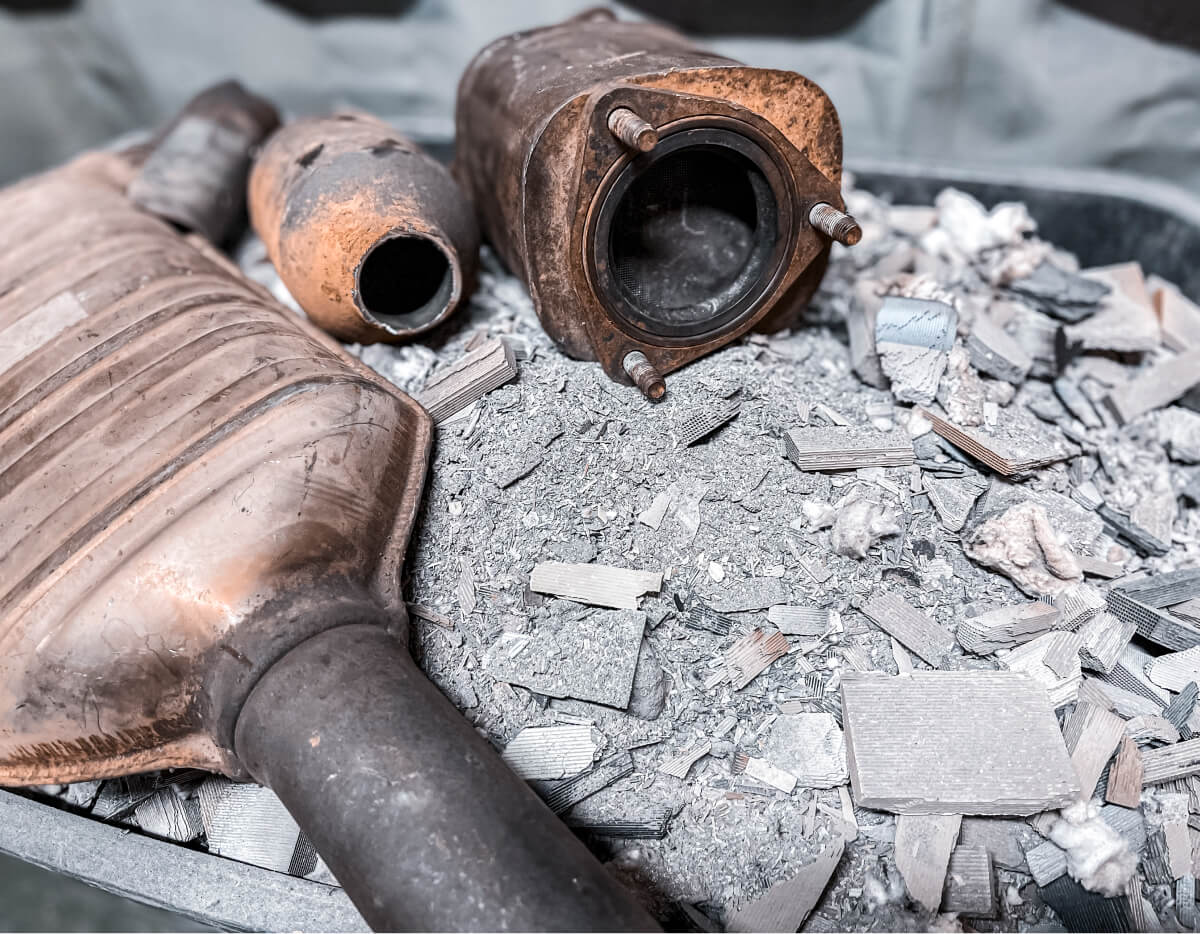
A catalytic converter sits in a car’s exhaust system. It contains a ceramic or metallic honeycomb structure coated with precious metals—typically platinum, palladium, and rhodium. These metals work as catalysts, meaning they speed up chemical reactions without being consumed. In everyday terms: the converter helps change the most harmful exhaust gases into less harmful compounds before the exhaust leaves the vehicle.
Because the converter needs heat to work efficiently, it’s designed to warm up quickly after the engine starts. Once it reaches operating temperature, it becomes highly effective at reducing key pollutants produced by combustion engines.
For a straightforward explanation of what catalytic converters are and why they exist, see Encyclopaedia Britannica — Catalytic Converter.
The Three-Way Conversion Process
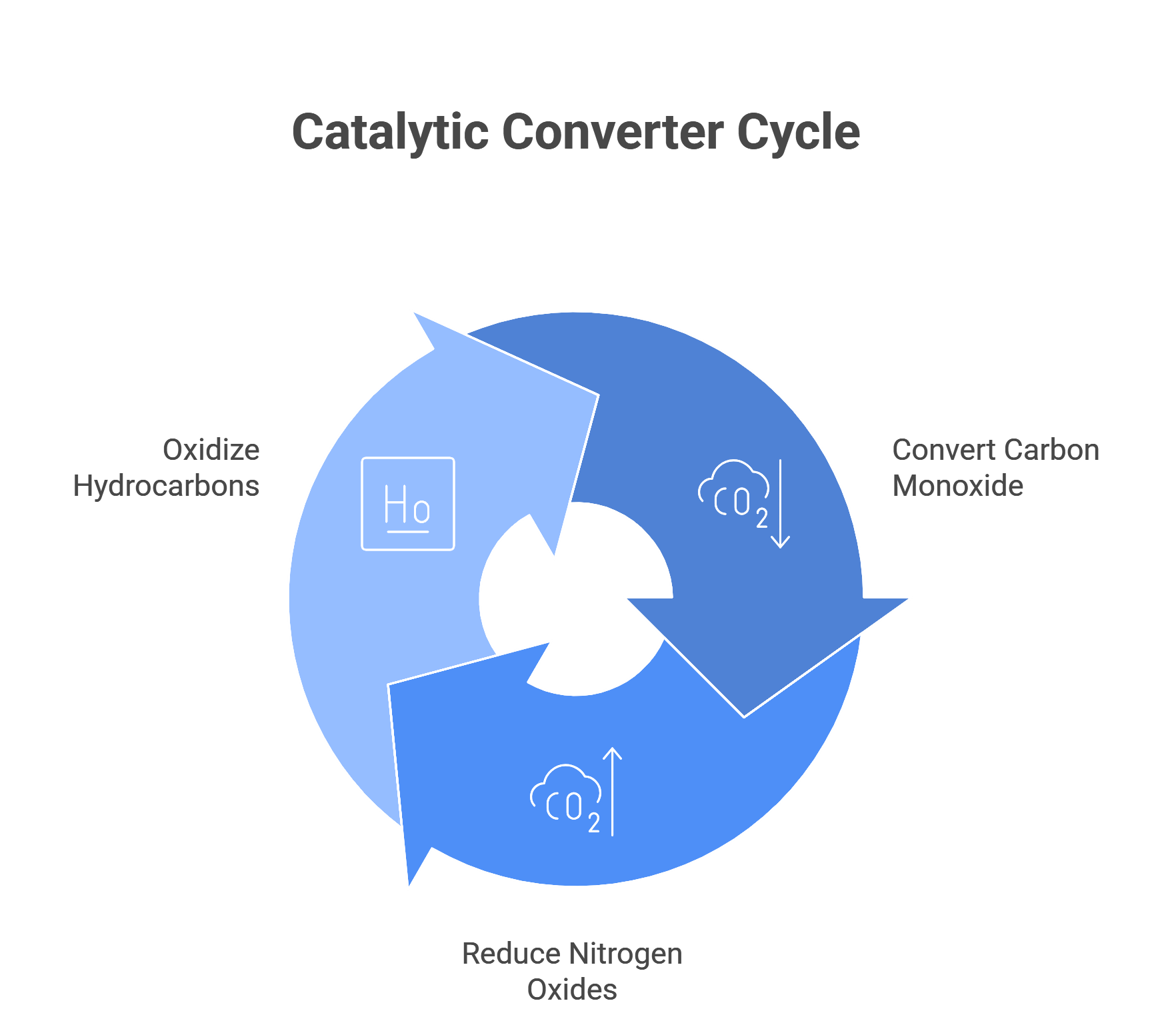
Most petrol vehicles rely on a “three-way” catalyst that targets three major pollutant categories. Here’s the simplified breakdown:
Carbon monoxide (CO) → carbon dioxide (CO2): Carbon monoxide is dangerous because it reduces the blood’s ability to carry oxygen. The converter oxidizes CO into CO2, which is less immediately toxic at typical exposure levels.
Nitrogen oxides (NOx) → nitrogen (N2) + oxygen (O2): NOx contributes to smog formation and can aggravate respiratory problems. The converter reduces these compounds into less reactive gases.
Unburned hydrocarbons (HC) → water vapor + CO2: Hydrocarbons are essentially leftover fuel. The converter oxidizes them into simpler compounds, reducing harmful emissions.
This is why catalytic converters are considered one of the most impactful additions to mainstream automotive emission control. They don’t eliminate pollution completely, but they significantly cut the most harmful exhaust components compared to engines with no converter at all.
A practical, plain-language overview can be found in a U.S. Department of Energy resource: U.S. DOE (EERE) — Catalytic Converters (PDF).
Why Catalytic Converters Matter for Health and Air Quality
Air pollution is not an abstract issue—people feel it. In dense traffic corridors, emissions contribute to poor air quality, especially when vehicles are older or poorly maintained. Catalytic converters help reduce pollutants that contribute to smog and respiratory irritation. That’s also why many health and environmental organizations treat pollutants like NO2 and CO as key air quality concerns.
If you want a credible, high-authority explanation of common air pollutants and how they affect health, see: World Health Organization — Types of air pollutants and health impacts.
When a converter is missing, hollowed out, internally broken, or blocked, emissions rise. And even if the vehicle still “drives fine,” the environmental impact can be significant. That’s one reason why responsible end-of-life handling matters: an old converter isn’t simply scrap metal—it’s an emission-control unit that may contain residues and fine particles.
For a wider, more educational overview that connects function, significance, and recycling need, see Catalytic Converters: Function, Significance, and the Crucial Need for Recycling.
The Real Reason Used Converters Have Value
The value of used catalytic converters comes from the precious metals inside them—primarily platinum, palladium, and rhodium. These metals are scarce, expensive to mine, and essential for many industrial processes. Recycling them reduces pressure on mining and helps keep valuable materials in circulation.
That’s also why pricing can change quickly: global precious metal markets move, and those movements influence local buy prices and demand. A unit that’s worth one amount today could be worth a different amount next month depending on metal prices and market demand.
For sellers, the key point is simple: the converter’s value is not based on “weight alone.” It’s based on recoverable metal content, unit type, condition, and current market pricing.
What Affects Catalytic Converter Prices?
Catalytic converter prices depend on several factors, but the biggest driver is the amount of platinum, palladium, and rhodium in the substrate. Other influences include the vehicle make and model, converter design and size, unit condition, regional demand, and global market movement. Because these metals are rare and valuable, prices can shift often—this is why a catalytic converter buyer must track market trends closely and align offers to current conditions.
Below is a simple reference table showing what typically changes a quote—without overcomplicating it.
| Pricing factor | What it influences | How to protect your payout |
|---|---|---|
| PGM content (Pt, Pd, Rh) | Main value driver; different units contain different loadings | Provide converter codes or vehicle details if available |
| Make/model + converter type | Catalog identification and expected metal range | Share year/engine size when you can |
| Condition and completeness | Impacts recoverable material and processing cost | Keep units intact; avoid damaging the substrate |
| Market movement | Changes buy prices and recycler demand | Get quotes close to sale date, not from old lists |
| Volume and logistics | Collection, handling, and service options | Bundle units when possible; ask about bulk collection |
Catalytic Converter Price List in South Africa: What It Really Means
When people search for a catalytic converter price list in South Africa, they usually expect a single fixed chart. In practice, “price lists” are often reference tools rather than permanent price tags. Many buyers use catalogs and internal coding systems to estimate a unit’s likely PGM content. Then they adjust the quote based on current metal markets, the unit’s condition, and local demand.
That’s why the best approach is not to rely on a forwarded screenshot or an outdated table. The best approach is to get your specific units assessed and quoted based on what they actually are and what they’re worth under current market conditions.
If you’re deciding between selling quickly or recycling through a fully compliant process, read Buying vs Recycling: Options for Old Catalytic Converters.
The Case for Catalytic Converter Recycling
Catalytic converter recycling is critical for both the environment and the economy. It reduces the need for new mining, helps conserve scarce metals, and prevents potentially hazardous residues from being mishandled or dumped. In other words: it’s not just about “getting paid for scrap.” It’s about handling an end-of-life emission component safely and responsibly.
A scientific study in the Journal of Hazardous Materials discusses environmental risks associated with end-of-life converters and supports sustainable recovery pathways: ScienceDirect — Journal of Hazardous Materials study on end-of-life catalytic converters.
For legal and policy context on responsible waste management in South Africa, see: South African Government — National Environmental Management: Waste Act (59 of 2008).
When recycling is done through a trusted facility, the goal is safe handling, accurate valuation, and controlled processing. This protects workers, communities, and the environment while ensuring precious metals are recovered efficiently.
How to Choose the Right Buyer (And Avoid Common Mistakes)
If you’re searching for catalytic converter buyers near me, focus on a few practical signals that usually separate a reliable buyer from a risky one:
Clear explanation of pricing: You should hear what affects value—unit type, condition, and market movement—not vague “flat rates.”
Safe, compliant handling: End-of-life converters can contain residues and dust. Proper handling matters.
Process transparency: A trustworthy recycler can explain collection, assessment, and payout expectations clearly.
Consistency: Quotes should make sense relative to market logic and unit identification.
Scrap Price vs. Real Value: Don’t Oversimplify It
Many people ask for one simple number: the catalytic converter scrap price. The challenge is that there isn’t one universal scrap price—because converters vary widely. Two units that look similar can have different internal metal loading. Even within the same manufacturer, different models and years can change what’s inside.
So, instead of chasing a single “best price on Google,” you’ll usually do better by getting a quote that reflects:
your exact converter type and code (if available),
the unit’s condition and completeness,
current precious metal market movement,
and the recycler’s processing and compliance standards.
This is exactly why specialized buyers exist—and why a serious recycler will ask for details rather than guessing.
Final Thoughts
Catalytic converters reduce harmful exhaust emissions and support better air quality. At the same time, they contain valuable metals that can be recovered through responsible recycling—reducing pressure on mining and preventing end-of-life units from being mishandled. The smartest path is simple: keep the unit intact, get a market-aligned quote, and work with a trusted recycler that can explain its process clearly.
If you’re ready to sell or recycle, choose a specialist that can give an accurate assessment and safe, compliant processing. That combination protects your payout and protects the environment—without shortcuts.