
Key Takeaways
- Scrap catalytic converters are bought by private collectors, scrap dealers, and licensed recyclers – the last of these usually pays the most because it values units on measured metal content.
- A legitimate buyer purchases from individuals, workshops, and businesses alike, and accepts all makes, models, and conditions – even damaged or incomplete units.
- Collection works two ways: drop-off at a branch for single units, or free pickup for bulk orders booked through an online form.
- After collection, each unit is identified by its code, then decoded and analysed for platinum, palladium, and rhodium content before an offer is made.
- Payment is typically immediate for small quantities and within 24-48 hours for bulk orders assessed by lab analysis.
- South Group Recycling buys and collects across Cape Town, Johannesburg, Durban, and Pretoria.
Who buys scrap catalytic converters?
Scrap catalytic converters are bought by three main types of buyer: informal collectors, general scrap dealers, and licensed recyclers. Collectors and dealers tend to offer a quick flat rate and resell your unit up the chain, which means their margin comes out of your payout. Licensed recyclers assay each unit and pay on the actual platinum, palladium, and rhodium it contains, so they can usually offer more for the same converter. The other difference is who they will deal with. Casual buyers often want only clean, high-value units, whereas established scrap catalytic converter buyers purchase from everyone – private car owners, mechanics, workshops, scrapyards, and fleets – and take all makes and models. South Group Recycling, for example, accepts units from Toyota, BMW, Mercedes-Benz, Volkswagen, Ford, and many others, whether you are selling one converter or managing regular volumes. According to Johnson Matthey’s 2026 PGM Market Report, autocatalyst recycling is forecast for double-digit growth in 2026, which keeps established buyers actively competing for converter stock.Where can I find scrap catalytic converter buyers near me?
You can find legitimate buyers by looking for licensed recyclers with a physical presence in your region rather than the closest anonymous yard. In South Africa, South Group Recycling operates four branches – Cape Town, Johannesburg, Durban, and Pretoria – covering the main metros, so most sellers are within reach of a facility or a collection route. When people search “scrap catalytic converter buyers near me,” the results mix collectors, dealers, and recyclers, so it pays to do a little due diligence. Shortlist two or three, and check that each one evaluates the unit properly, explains its pricing, and issues a receipt tied to your details. For a broader look at your options, South Group’s rundown of where to sell your catalytic converter and its guide on where to sell a catalytic converter near you in South Africa are useful starting points.Do buyers accept used, damaged, or all types of converter?
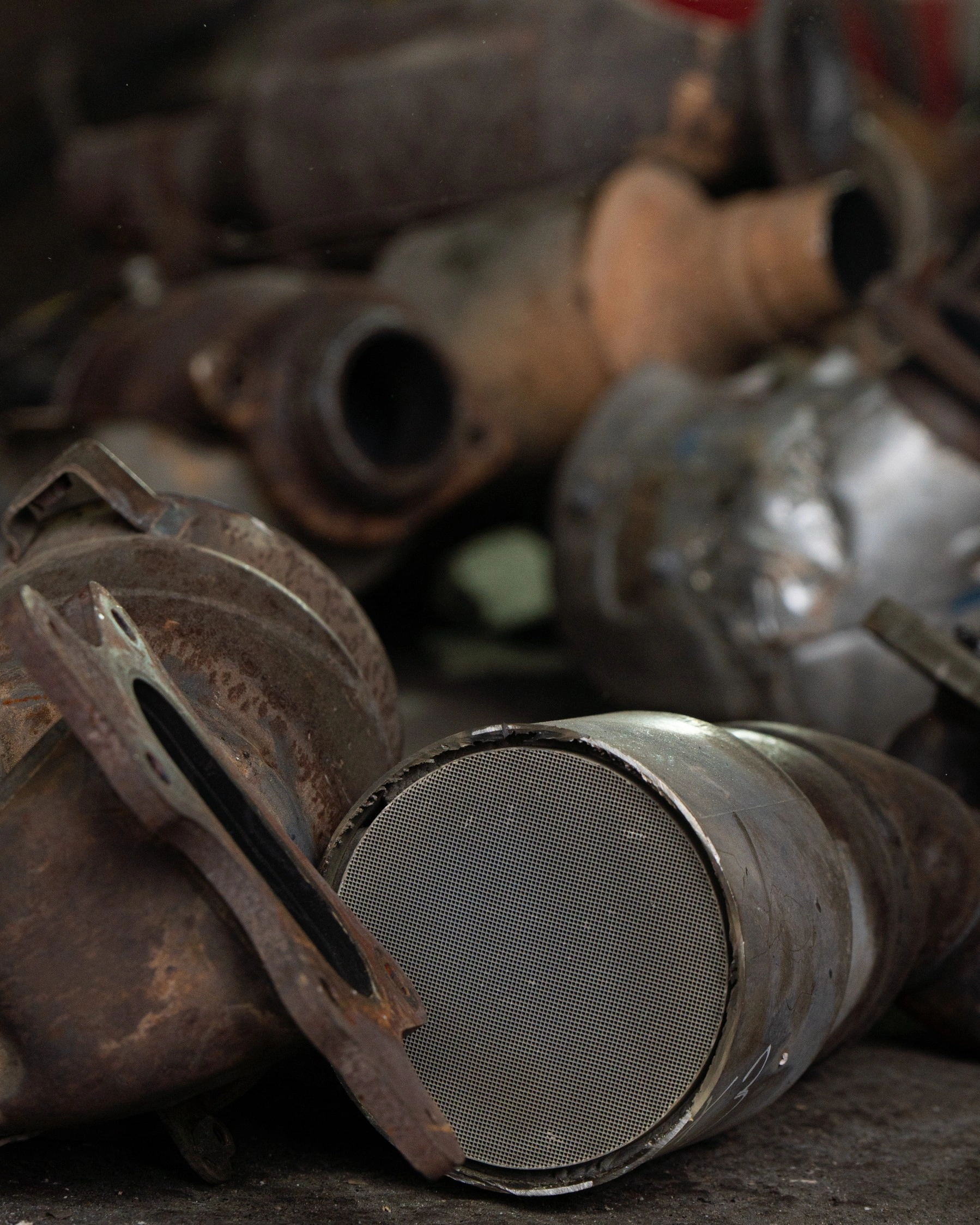
Yes – a legitimate recycler accepts used, damaged, and incomplete units, because the value lives in the metals inside rather than the outward condition. This matters, because sellers often assume a cracked or rusty unit is worthless. In reality, even a damaged converter retains recoverable metal, provided the ceramic honeycomb has not been emptied.Do used catalytic converter buyers take aftermarket units?
Reputable used catalytic converter buyers take both original equipment (OEM) and aftermarket units, across every make and model. Aftermarket units generally hold less precious metal than OEM ones, so they are worth less, but they are still bought and assessed on their measured content. If you’re deciding whether to sell a used unit, get it priced, or list it for sale, see the guide on used catalytic converters: sell, price or list for sale.What “we buy catalytic converters” should really mean
When a buyer advertises “we buy catalytic converters” of all types and conditions, it is a good sign they assess on metal content rather than cherry-picking only pristine stock. A buyer that takes every make, model, and condition is usually pricing on what is inside the unit, not on how clean it looks.| Buyer type | What to expect |
|---|---|
| Informal collector | Fast flat-rate cash offer; little transparency; resells your unit on. |
| General scrap dealer | Convenient, but may apply a rough category price rather than an assay. |
| Licensed recycler | Assays each unit, prices on measured metal content, issues documentation. |
How does catalytic converter collection work?
Collection works in one of two ways, depending on how many units you have: drop-off at a branch, or a free pickup for bulk loads. Either way, the unit is logged and assessed the same way, so the route you choose does not change how your converter is valued.Drop-off at a branch
For a single converter, you can drop it off at your nearest branch for an on-the-spot evaluation. This is the quickest route for individual sellers with one or two units.Free collection for bulk orders
For a workshop, scrapyard, or fleet with larger volumes, a free collection service brings the team to your location, saving you the trip and the transport cost. Booking is simple: you complete a short online form with your details and the number of units, and the regional team contacts you to arrange a time. This service is designed for bulk orders and is especially cost-effective for businesses handling regular volumes.| Option | Best for | How it works |
|---|---|---|
| Drop-off at a branch | Single units and small quantities | Bring the unit in for a free, on-site evaluation. |
| Free collection | Bulk orders, workshops, and fleets | Book via the online form; the team collects from your site. |
What happens after your converter is collected?
After collection, each converter goes through a clear sequence: identification, analysis, offer, and payment.What Happens After Your Converter Is Collected
A transparent, documented process – so your price is based on measured metal content, not guesswork.
-
1
Collection
Dropped off at a branch, or collected free for bulk orders.
-
2
Identification
Each unit is logged and identified by its serial or manufacturer code.
-
3
Analysis
Decoded and analysed by XRF or ICP to measure platinum, palladium, and rhodium content.
-
4
Offer
Priced on the measured content against current metal-market values.
-
5
Payment
Immediate for small quantities; within 24-48 hours for bulk orders after assessment.
-
6
Refining
Recovered metals are sent for responsible refining and returned to industry.
South Group Recycling – south-group.co.za
Identification and analysis
First, the unit is collected and identified by its unique serial or manufacturer code. Next, it is decoded and analysed – typically with X-ray fluorescence (XRF) or inductively coupled plasma (ICP) equipment – to determine its exact platinum, palladium, and rhodium content.Offer and payment
That measured content, priced against current metal-market values, produces the offer. Because the figure is based on what the unit actually contains, it reflects your converter’s real value rather than a rough guess. Payment follows quickly: for individual units or small quantities, it can often be arranged immediately, while bulk orders are generally processed and paid within 24 to 48 hours of assessment. A compliant recycler documents the transaction throughout, which keeps the sale traceable and lawful. According to the U.S. Geological Survey, the automotive industry has been the principal consumer of platinum-group metals since 1979, so the platinum, palladium, and rhodium recovered from your converter feed straight back into a critical supply chain.How should you prepare a converter for collection or sale?
You should keep the unit intact and identifiable, and gather any supporting paperwork before it is collected. A few simple steps make the process faster and protect your offer. Record the vehicle details and any part numbers stamped on the converter, photograph both ends of the honeycomb and the shell, and brush off loose dirt without washing or stripping the substrate. Then package the unit so dust stays contained, and label it with a reference. Keeping records also helps you sell legally and smoothly. Ask for a receipt with your details when selling, or a weight ticket or sampling report when recycling. If you manage several units, a simple spreadsheet of vehicle references, dates, and photos speeds up reconciliation later. For more on getting the strongest offer, see South Group’s guide on maximising the value of your catalytic converter before recycling.How do you choose a trustworthy buyer?
Choose a buyer that is licensed, transparent about pricing, and able to document the sale. The clearest signs of a trustworthy operation are consistent: it complies with environmental and hazardous-material regulations – such as the NEMWA Act 2018 – it assesses each unit with proper testing equipment, it explains how it reached the figure, and it issues a receipt tied to your identity and the item. Fast, traceable payment is another good indicator. The red flags are just as clear. Be cautious of anyone who quotes without inspecting the unit, offers a suspiciously high price to reel you in, refuses documentation, or wants a cash-only deal with no paper trail. A licensed, ISO-aligned recycler that welcomes questions and prices on measured metal content is the safer choice – and usually the more profitable one.Conclusion
Selling a scrap converter comes down to two things: choosing the right buyer and understanding how collection works. The right buyer is a licensed recycler that takes all makes, models, and conditions, values your unit on measured metal content, and offers both drop-off and free bulk collection. Get those right, and turning an old converter into a fair, documented payout is straightforward. To arrange a drop-off or book a collection, contact the South Group Recycling team and sell with confidence.FAQ
Who buys scrap catalytic converters near me in South Africa?
Licensed recyclers, scrap dealers, and informal collectors all buy scrap catalytic converters, but a licensed recycler such as South Group Recycling usually pays the most because it assays each unit. South Group buys and collects in Cape Town, Johannesburg, Durban, and Pretoria, from both private sellers and businesses.
Will a scrapyard buy a single catalytic converter, or only bulk?
Both. You can drop off a single unit at a branch for an on-site evaluation, or book free collection for larger quantities. There is no requirement to sell in bulk, though collection is reserved for bigger orders because it brings the team to your location.
Do buyers accept damaged or incomplete catalytic converters?
Yes. Even damaged, rusty, or incomplete units retain value, because the worth is in the platinum, palladium, and rhodium inside rather than the outward condition. The main exception is a unit whose ceramic honeycomb has been emptied, as that removes the recoverable metal.
Do you buy used and aftermarket converters, or only OEM?
Reputable used catalytic converter buyers take both original equipment (OEM) and aftermarket units, across all makes and models. Aftermarket units generally contain less precious metal, so they are worth less, but they are still bought and assessed on their measured content.
Is catalytic converter collection free?
Free collection is offered for larger recycling orders. You complete a short online form, and the regional team arranges a pickup from your site, which saves time and transport costs for workshops, scrapyards, and fleets. Single units are usually dropped off at a branch instead.
How soon do you get paid after selling a scrap converter?
For individual units or small quantities, payment can often be arranged immediately at the facility. For bulk orders that require laboratory analysis, payment is typically processed within 24 to 48 hours of assessment. Licensed buyers pay through traceable methods rather than untracked cash.
What documents do I need to sell a scrap catalytic converter?
Bring proof of identity and, ideally, proof that the converter came from your vehicle, along with any part numbers or vehicle references. A legitimate buyer records these details and issues a receipt, which keeps the transaction traceable and lawful – increasingly important as South Africa tightens rules around scrap-metal trade.
How is the price for a scrap converter decided?
The price is based on the unit’s measured platinum, palladium, and rhodium content, priced against current metal-market values, together with the type and condition of the converter. This is why an assay-based buyer can quote accurately, while a flat per-unit rate often undervalues the unit.