
Introduction: South Africa’s catalytic converter market is moving into a split era. Pure battery EVs do not have exhaust systems, so they do not use catalytic converters. Hybrids still run petrol engines, so they still need them. That simple difference will shape factory demand, scrap flows, theft risk, and workshop decisions through 2030. It also means businesses that keep a close eye on catalytic converter price trends today will be better prepared for the next few years.
Key Takeaways
- EVs do not use catalytic converters, but hybrids still do.
- South Africa’s converter market will shrink more slowly than many people expect.
- Hybrid demand can support OEM and scrap activity even as EV share grows.
- Exports have eased since 2021 as model mix and demand patterns changed.
- Scrap yards need stronger traceability, grading, and legal controls.
- Fleet owners should plan now for aging ICE and hybrid converters.
- Workshops can recover value from failed units if they handle them correctly.
Why does South Africa’s converter market matter so much?
It matters because catalytic converters have been one of the country’s most important automotive export items, and they still carry real value at end of life.
For years, “cats” were not just another exhaust part. They sat at the meeting point of South Africa’s vehicle industry, emissions rules in export markets, and demand for recoverable precious metals. That is why the market became so large and why any shift toward EVs now matters far beyond scrapyards.
According to NAAMSA, catalytic converters have ranked among South Africa’s leading automotive export components. That history helps explain why the local market has been watched so closely by manufacturers, exporters, recyclers, and criminal networks alike.
How did catalytic converters become such a major export line?
They became a major export line because global vehicle production needed emissions-control parts, and South Africa built a strong automotive supply base around that demand.
When overseas markets tightened emissions standards, converter demand rose. South Africa was well placed to feed that demand through established auto manufacturing and component production. In simple terms, if the world kept building petrol and diesel vehicles, it kept needing converters, and South Africa benefited from that trade.
There was also a second reason. A used converter is not just scrap steel. It contains recoverable metals, which gave the part value both when new and when removed from a vehicle. That dual value helped create a large local market for recovery, grading, and export.
Why have exports fallen since 2021?
Exports have cooled since the 2021 peak because the global vehicle mix has changed and converter-bearing models no longer dominate in the same way.
When more battery EVs enter key markets, fewer vehicles need converters at all. At the same time, supply chains have been less stable than they were before, and buyer demand has shifted between petrol, diesel, hybrid, and fully electric models. A lower share of traditional internal combustion output naturally puts pressure on converter exports.
That does not mean the market disappears. It means the market changes. The mix becomes more uneven, more model-specific, and more sensitive to policy and production changes in export markets.
If you need a plain-language way to track local value swings, South Group has a useful guide to tracking converter and scrap values in South Africa.
What changes when EVs and hybrids take a bigger share?
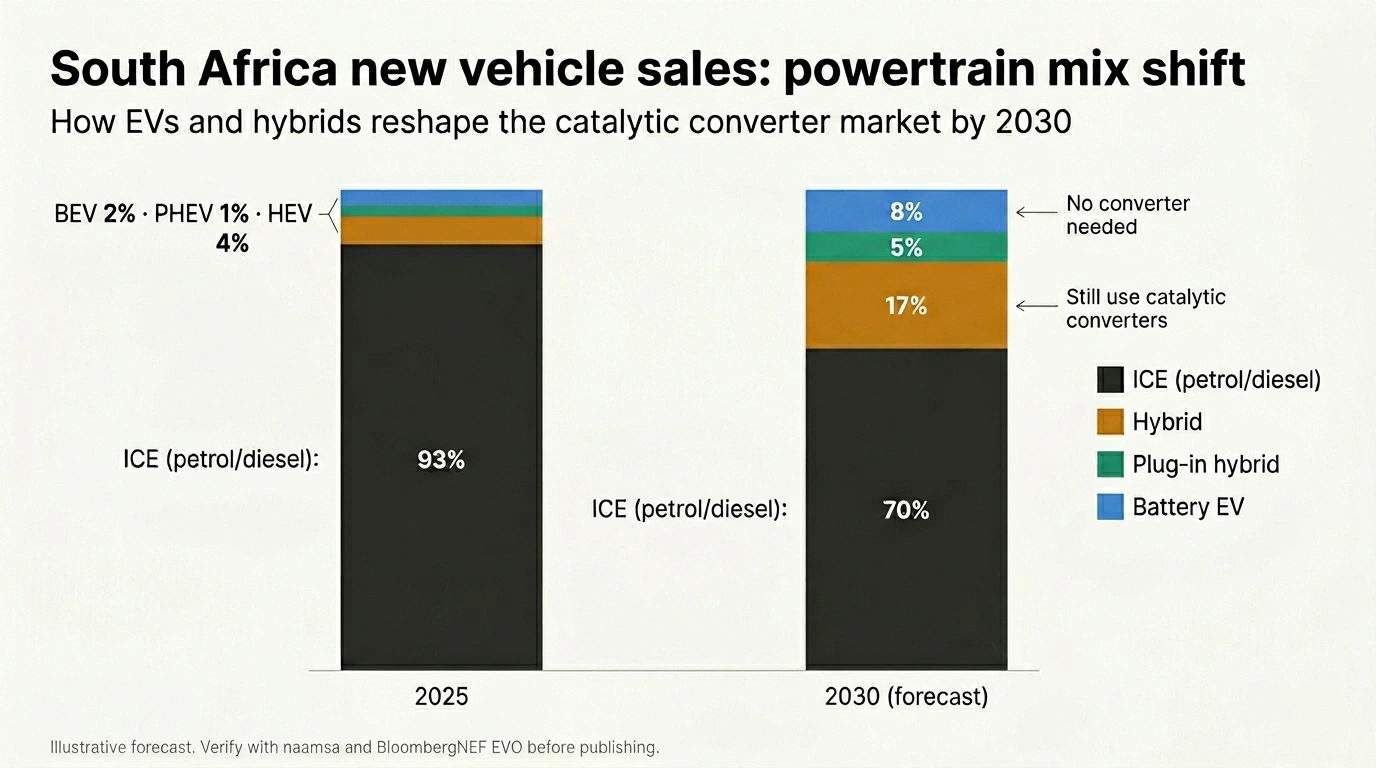
The core change is simple: EV growth removes converters from part of the market, while hybrid growth keeps them in play.
That split matters because people often group EVs and hybrids together as “electrified” vehicles. For catalytic converters, that shortcut causes confusion. A hybrid still burns fuel. A battery EV does not. Therefore, their effect on converter demand is very different.
Do EVs need catalytic converters?
No. A battery EV has no combustion engine and no exhaust gas stream, so it does not need a catalytic converter.
This is the cleanest demand shock facing the sector. Every shift from an ICE vehicle to a battery EV removes one potential converter from the production market and one future converter from the scrap market. If EV share rises quickly in a given export program, converter demand linked to that program falls with it.
Do hybrids still need catalytic converters?
Yes. Hybrids still use internal combustion engines, so they still need catalytic converters.
In many cases, hybrids can place tough demands on emissions systems because the engine may cycle on and off more often, and cold-start control becomes important. The main point for the market is clear: hybrids keep converter demand alive, even as total fuel use drops. That is why a rise in hybrid output does not hurt the sector the same way a rise in battery EV output does.
How do different powertrains affect converter demand by 2030?
They affect demand in very different ways. ICE vehicles keep full demand, hybrids preserve meaningful demand, and EVs remove it.
The table below shows the practical market effect.
| Powertrain type | Uses a catalytic converter? | Effect on new local demand | Effect on future scrap supply |
|---|---|---|---|
| Petrol or diesel ICE | Yes | Supports full demand for converters | Creates steady future removed-unit supply |
| Hybrid | Yes | Supports ongoing demand, though model mix may change | Keeps a meaningful scrap stream in place |
| Plug-in hybrid | Yes | Still supports demand while battery range grows | Adds future scrap units, though not like full ICE fleets |
| Battery EV | No | Removes converter demand from that vehicle line | Creates no future converter scrap from that vehicle |
This is why 2030 will likely look mixed rather than binary. South Africa’s converter market may shrink in some channels, but it can stay active where hybrids and ICE fleets remain common.
What does this mean for OEM manufacturing plants in South Africa?
It means plant-level demand will depend more on model mix than on broad headlines about electrification.
If a local plant builds models for markets that still want ICE or hybrid vehicles, converter demand can remain healthy. If that same plant shifts toward battery EV output, converter demand attached to that line falls sharply. The impact is specific, not uniform.
How could model mix reshape plant demand?
Model mix can reshape plant demand very quickly because converters are tied directly to the type of powertrain a factory builds.
Plants that keep assembling petrol, diesel, or hybrid vehicles will still need converter supply, testing, and replacement channels. Plants that gradually add battery EV output may see converter volumes thin out over time. In practice, this means procurement teams, component planners, and local suppliers need to track each vehicle program, not just the word “electrified.”
It also means an auto catalyst remains relevant in the near term. Even with more battery vehicles on the road, a large share of production and aftersales demand can still come from engines that require emissions control.
Will hybrid growth offset EV-related losses for local plants?
It can offset some losses, but not all of them. Hybrids support converter demand, yet they do not replace every unit lost when a model line goes fully electric.
The key point is timing. Through 2030, hybrids can act as a bridge. They help keep converter volumes alive while global markets move at different speeds. For local plants, that bridge matters because it can soften the drop rather than erase it.
That softer landing is important for suppliers, refitters, and workshops. They may see fewer units in some channels, but they are unlikely to see the market vanish overnight.
What does this mean for scrap yards and exporters?
It means the used-converter trade should remain active for years, but the rules around origin, legality, and grading will matter more than ever.
South Africa will still have a large installed base of ICE and hybrid vehicles for a long time. Those vehicles will age, fail, get repaired, get written off, or leave fleets. Each event can create a removed converter. So while new-vehicle EV growth reduces future supply, the current vehicle base keeps the scrap stream alive well into the next decade.
Why will scrap supply stay active even if EV sales grow?
Scrap supply will stay active because the existing fleet is far larger than the annual EV inflow, and old ICE vehicles do not disappear quickly.
Fleet cars, delivery vehicles, minibuses, bakkies, and private passenger cars all age on their own timelines. Many stay on the road for years after their warranty period ends. That means workshops and scrapyards will continue handling failed or removed converters long after EV headlines become common.
Yards that track catalytic converter scrap price movement by code, shell type, and condition will usually make better decisions than yards that buy mixed stock blindly.
What risks do scrap yards and exporters need to control?
They need to control theft, illegal trade, poor records, and weak grading. Those risks can destroy margin and create legal trouble.
Theft remains a real issue because converters carry recoverable value and can be removed quickly from vehicles. The compliance side is just as serious. According to SARS, customs seized illegal catalytic converters valued at R21-million. That is a strong reminder that the sector needs traceability and lawful handling, not casual trading.
For exporters and local buyers, the practical lesson is clear. Know the source of each unit. Record part numbers where possible. Keep intake logs. Separate damaged stock from intact stock. Do not mix lawful removed units with material of unclear origin. In a tighter market, clean paperwork matters even more.
If you want a simple background read on how the local recovery chain works, this overview of the recycling process in South Africa is a good place to start.
What should South African fleet owners and workshops do over the next 5 to 10 years?
They should treat converters as managed assets, not as waste, and they should build a clear process now rather than later.
That means planning for diagnosis, lawful removal, storage, records, and sale. It also means accepting that there is no single nationwide rate for every unit. Converter value depends on the exact part, its condition, and the recovery route.
How should fleets manage aging ICE and hybrid vehicles?
They should inspect converters early, keep maintenance records, and avoid waiting until failure creates a bigger repair bill.
Start with routine diagnosis. Many fleet managers ignore the exhaust line until a vehicle loses power or fails a test. That costs time. Watch for bad catalytic converter symptoms such as sluggish acceleration, rattling from the exhaust area, poor fuel economy, warning lights, unusual heat, or a sulfur-like smell. When those signs appear, test the vehicle properly before replacing parts at random.
It also helps to separate three groups in the fleet. First, vehicles near end of life. Second, vehicles worth repairing. Third, hybrids likely to stay in service for years. Each group needs a different replacement and disposal plan.
When should a converter be removed, replaced, or sold?
It should be removed or replaced when diagnosis confirms failure, damage, theft loss, or lawful end-of-life dismantling. It should then be stored and sold through a documented channel.
Do not remove working converters from roadgoing vehicles just because they hold scrap value. That creates legal, emissions, and resale problems. Instead, remove units only during legitimate repair, collision write-off, or dismantling work. Tag the unit to the job card or vehicle record. Keep it dry and separate from mixed scrap.
There is also no single catalytic converter price in South Africa that applies to every unit. Code numbers, substrate type, contamination, shell damage, and buyer method all affect what a used converter is worth. Therefore, workshops should avoid spot deals based only on guesswork.
What actions make the biggest difference over the next decade?
A few practical actions make the biggest difference: better diagnosis, better records, and better recovery partners.
The table below shows a simple action plan for fleets and workshops.
| Time frame | Action | Why it matters |
|---|---|---|
| Now to 12 months | Create a written intake and removal process for failed converters | Reduces loss, mix-ups, and compliance risk |
| Now to 12 months | Train staff to identify common failure signs and theft damage | Improves diagnosis and speeds repair decisions |
| 1 to 3 years | Track removed units by vehicle, date, and part code | Makes valuation and audits far easier |
| 1 to 3 years | Review which fleet segments are shifting to hybrid or EV | Helps predict future converter replacement volume |
| 3 to 5 years | Refresh disposal agreements and approved buyer lists | Keeps recovery routes lawful and competitive |
| 5 to 10 years | Plan for lower ICE volume but ongoing hybrid and legacy fleet work | Supports realistic staffing, stock, and revenue planning |
How can workshops recover value without creating risk?
They can recover value by sticking to documented repairs, secure storage, and verified selling channels.
In practice, that means no loose bins of mixed units and no informal buying from unclear sources. Use serial or code notes where available. Match each removed part to a work order. Store units in a locked area. Then move them through a specialist route that understands grading and lawful recovery.
For workshops that want a compliant outlet as the market changes, catalytic converter recycling remains one of the most practical ways to recover value from removed units while keeping the paper trail clear.
Summary
By 2030, South Africa’s converter market will not vanish, but it will look different. Battery EVs remove converters from the vehicle altogether. Hybrids keep them in the game. That means OEM plants will feel the change according to model mix, not hype. Scrap yards and exporters will still see supply, but the market will reward lawful sourcing, clean records, and accurate grading. Fleet owners and workshops should prepare now by diagnosing failures early, separating lawful removed units, and using specialist recovery channels. For businesses that need help with compliant recovery, South Group Recycling is one option to consider as the market shifts.